
Can AI Vision Detect "Internal Injuries" in Materials? A Comprehensive Material Checkup

An experienced technician can spot a coating's condition with just a flashlight, but when dealing with thousands of parts, human eyes aren't enough. Can AI vision perform a "check-up" on materials to detect subtle internal damage?
Introduction
Veteran technicians can spot a coating's condition at a glance with a flashlight and decide if it's still usable. But when inspecting thousands of components requires consistent, auditable judgments, human eyes alone fall short. This raises a key question: Can AI perform "health checks" on materials to detect subtle internal defects?
② Common Sense: Make "a glance" quantifiable
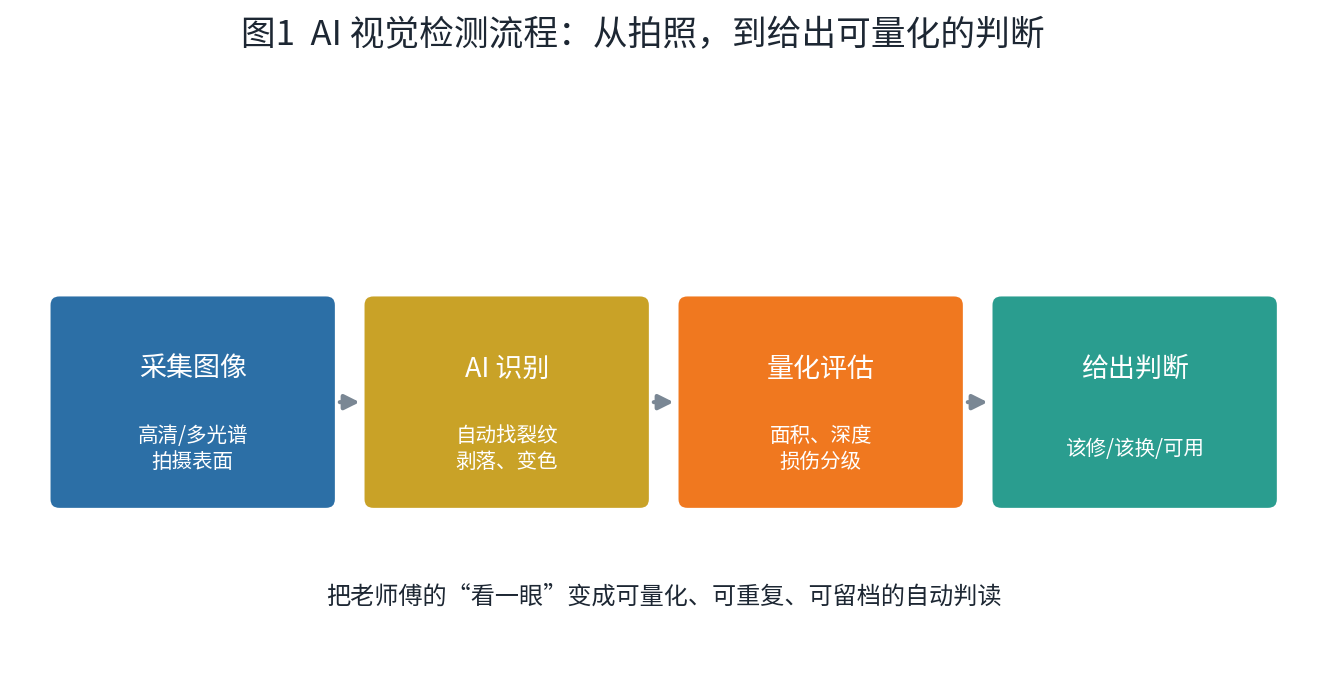
The AI visual inspection approach transforms expert judgment into a quantifiable process: high-definition or multispectral cameras capture surface images, which AI then automatically analyzes to detect defects like cracks, spalling, and discoloration. It quantifies area and depth, classifies damage severity, and finally determines whether repair, replacement, or continued use is appropriate. This effectively converts a master technician's "quick glance" into an automated, quantifiable, repeatable, and auditable evaluation.
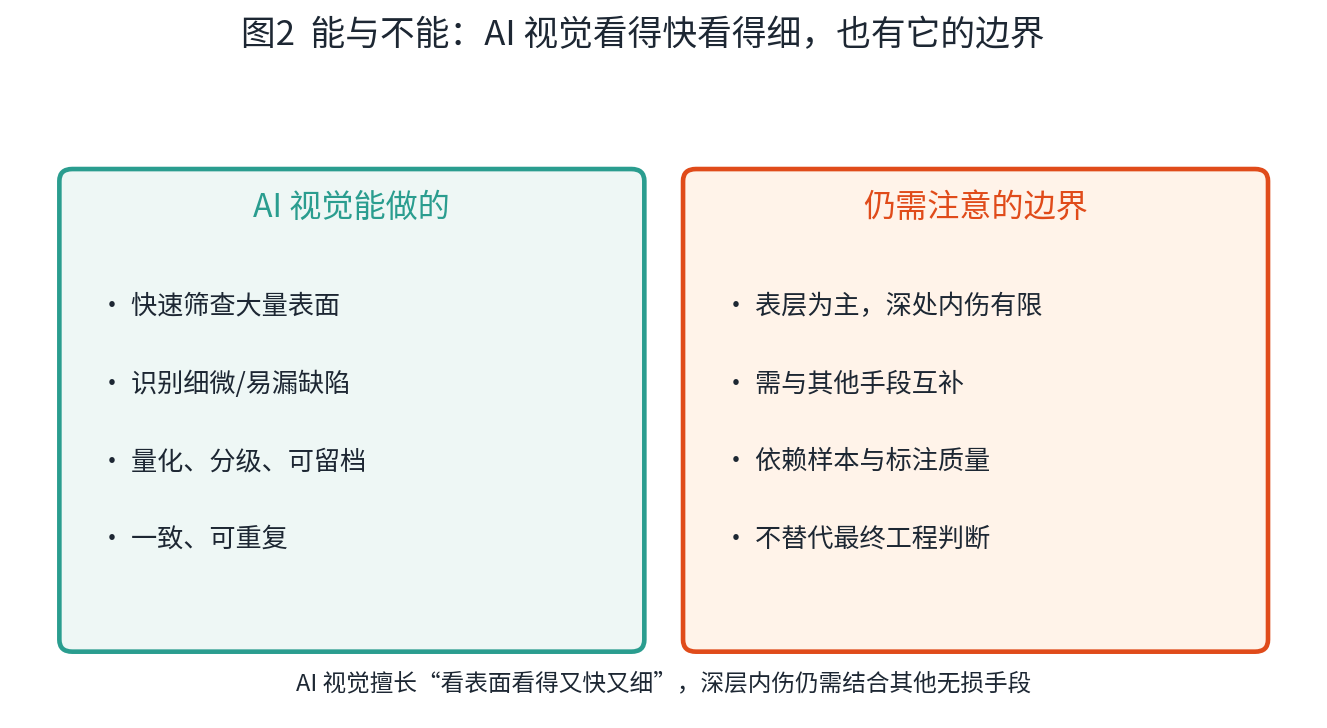
AI vision excels at rapidly screening large volumes of surfaces to detect subtle defects that human eyes often miss, delivering consistent, repeatable, and auditable results. However, it has limitations: it primarily focuses on surface-level issues and has limited capability in identifying deep internal damage. It should complement other non-destructive testing methods, with performance heavily dependent on the quality of samples and annotations. Ultimately, it cannot replace final engineering judgment. Its strength lies in inspecting surfaces quickly and precisely; detecting deep internal flaws still requires other techniques.
④ Challenges: Scarcity of defect samples and difficulty in standardizing criteria
Real failure samples are often scarce and expensive, with defect patterns constantly shifting. The key hurdles for practical AI vision lie in accumulating high-quality labeled data and standardizing the criteria for "how severe does a defect need to be before repair is required." The technology itself is straightforward; the real challenge lies in data and standards.
5. Tianyi's Perspective: AI as Part of the Detection System
Tianyi Quan'an addresses industry testing pain points by integrating AI vision into the thermal protection inspection framework. This enhances efficiency and consistency in surface screening, then combines with calibration and other non-destructive methods to deliver more comprehensive interpretation capabilities. We demonstrate a methodology—not a universal "black box." Ultimately, inspection credibility relies on traceable approaches.