
Why Coatings Fail: From Crack Initiation to Delamination

Why do high-performance coatings fail over time? The answer isn't sudden failure, but a gradual process starting from invisible micro-cracks and ending in widespread peeling. Understanding this progression is key to understanding coating lifespan.
Introduction
Why do high-performance coatings fail over time? The answer isn't sudden failure, but a gradual process starting with invisible micro-cracks and ending in widespread peeling. Understanding this progression is key to understanding a coating's true lifespan.
2. Common Sense: Failure is a gradual process
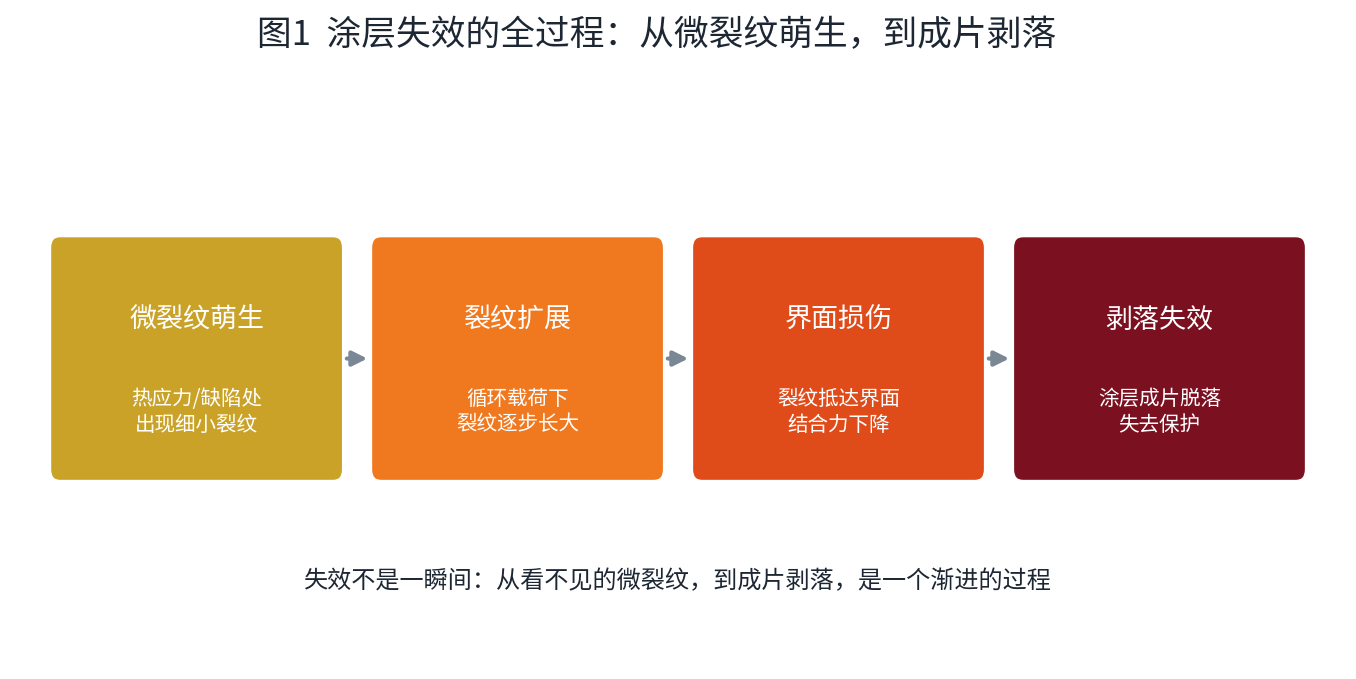
Coating failure typically occurs in four stages: microcracks initiate at sites of thermal stress or defects, propagate under cyclic loading, reach the interface causing bond degradation, and finally result in spallation and loss of protection. This process is usually gradual rather than instantaneous.
③ Reality: The failed "main battlefield" is in the interface
The coating withstands external heating and erosion, causing internal microcracks to proliferate. However, the critical "battlefield" is often the interface between the coating and the substrate: damage accumulates here, and delamination occurs here. Once delamination happens and the substrate is exposed, rapid overheating follows. Therefore, a coating's lifespan depends less on its heat resistance and more on how many cycles of damage accumulation its interface can endure.
Challenge 4: Invisible, yet critical to lifespan
Microcracks and interfacial damage are often hidden beneath the surface, invisible to the naked eye. By the time visible delamination occurs, failure is typically imminent. Detecting these latent defects early and predicting remaining service life represent the most challenging yet valuable aspects of coating reliability research.
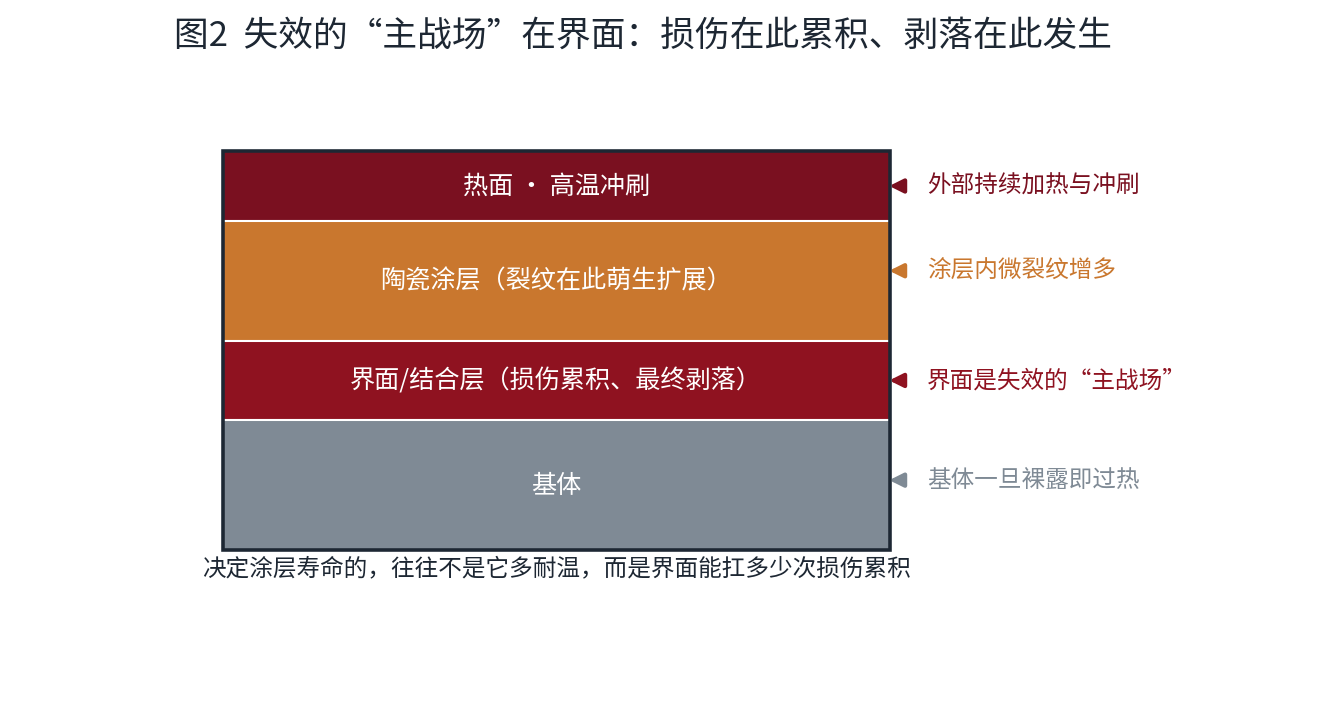
⑤ Tianyi Perspective: Center the Interface and Lifespan
At Tianyi Quanan, we prioritize interface bonding and spallation resistance alongside temperature tolerance in the R&D of precursor ceramic coatings. We validate durability through thermal cycling tests that measure how many cycles a coating can endure. Simultaneously, we leverage AI vision to detect latent damage early. Understanding failure modes is key to extending service life—the core challenge of reusable thermal protection systems.
6. Further Reading
Thermal Barrier Coating (TBC)The value of 200 microns on a blade
What's the difference between reusing it for the 10th and 1th time: Coating decay curves