
Ceramizable Materials
Liquid at room temperature, armor when exposed to fire.
2. Common Knowledge: What Is Ceramic-Formable? — A Coating at Room Temperature, Turning Into an Armor When Exposed to Fire
Imagine a material that, at room temperature, is soft, flexible, and easy to apply like ordinary paint. But when exposed to high heat or flames, it transforms within minutes into a hard ceramic shell that securely protects the underlying structure. This isCeramifiable MaterialAn intelligent protective material capable of "in-situ ceramic generation" during fires or extreme thermal environments.
Its core principle is straightforward: low-melting glass powders and ceramic fillers are pre-dispersed within a polymer matrix. At ambient temperature, the polymer provides flexibility and adhesion. When heated to a specific threshold (typically 300~600°C), the polymer begins to decompose while the glass powder softens and melts, bonding the residual ceramic particles together to form a dense, continuous ceramic protective layer. This ceramic shell effectively blocks heat and oxygen from reaching the interior, preventing the substrate from burning through.
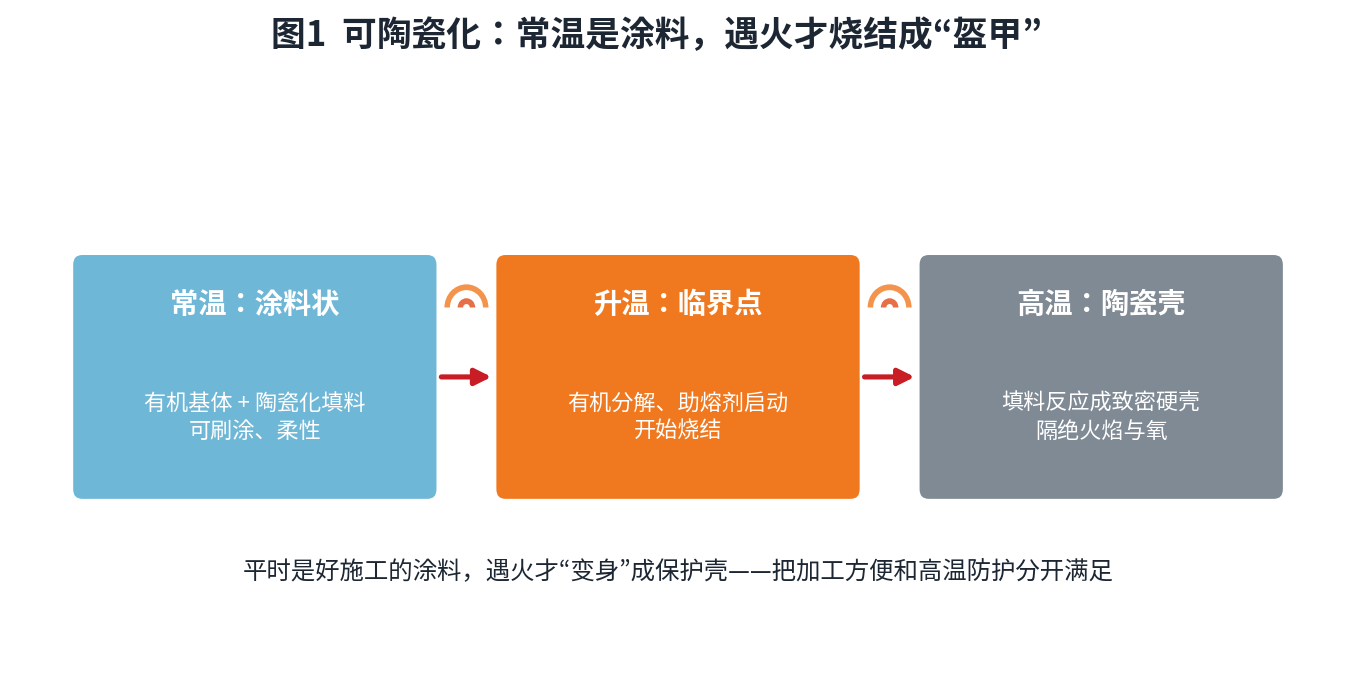
Three Key Elements for Ceramic-Forming
- polymer matrixProvides flexibility, adhesion, and workability at ambient temperature. Common systems include silicone resins, silicones, and acrylics. The choice of matrix determines the application method and initial mechanical properties.
- Low-melting glass powder: This is the key trigger for "ceramization." The softening temperature of glass powder typically ranges from 400 to 700°C, allowing it to melt and flow within the polymer decomposition temperature window to act as a "glue" between ceramic particles. The composition and particle size of the glass powder directly determine the density and strength of the resulting ceramic layer.
- Ceramic Packing: Provides the skeleton and high-temperature resistance for the final ceramic shell. Common fillers include mica, kaolin, alumina, boron nitride, and other sheet-like or fibrous minerals. The morphology and ratio of these fillers determine the thermal insulation and thermal shock resistance of the ceramic layer.
The synergy of these three elements enables the ceramic-formable material to achieve...One Material, Multiple Forms"At room temperature, it is a flexible coating; at moderate temperatures, it enters a transitional state; and at high temperatures, it becomes a rigid ceramic shell. This ability to adaptively deform in response to temperature changes is beyond the capabilities of traditional single-form materials."
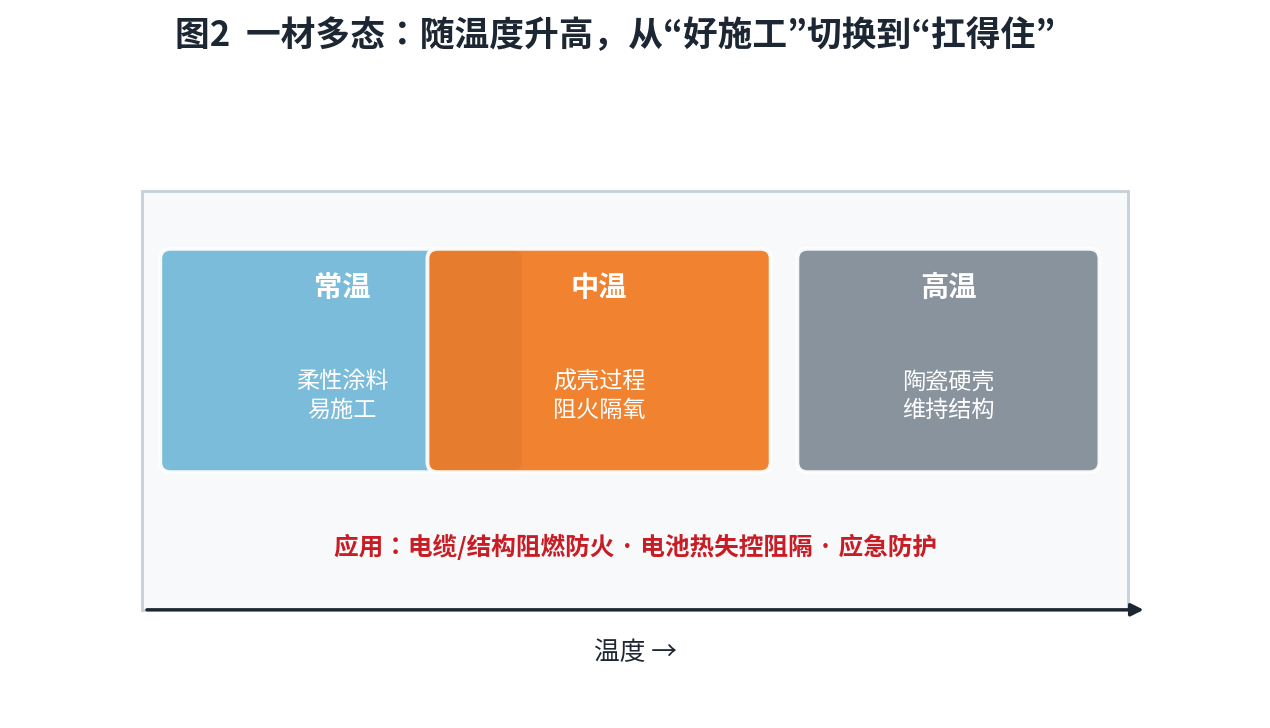
③ Reality: Typical Applications of Ceramizable Materials
Ceramic-forming materials, with their unique "soft and gentle at normal temperatures, rigid at high temperatures" properties, have found applications across multiple sectors:
Cable Fire Protection
This is currently the most mature application scenario. After applying a ceramicizable coating to power cables or communication optical fibers, the coating rapidly transforms into a hard ceramic shell upon fire exposure, preventing flame spread and maintaining circuit integrity for a specified duration. Compared to traditional intumescent fire-retardant coatings, the ceramic shell formed by ceramicizable coatings is denser, more resistant to erosion, less prone to peeling, and offers a longer fire-resistance rating.
Fireproofing for Structural Steel in Buildings
Steel loses most of its load-bearing capacity when exposed to temperatures above 500°C. Applying ceramicizing fireproof coatings to steel beams and columns forms a ceramic layer upon exposure to fire that not only provides thermal insulation but also withstands water spray impact from firefighting systems. This makes it more suitable than traditional intumescent coatings for scenarios requiring higher fire resistance ratings.
Thermal Runaway Protection for New Energy Batteries
During thermal runaway, power batteries release significant heat and high-temperature gases. Applying a ceramic-forming coating between cells or on module housings creates an instant ceramic barrier upon thermal runaway, slowing heat propagation to adjacent cells and buying critical time for passenger evacuation. This is one of the fastest-growing application areas in recent years.
Aerospace Cable and Tubing Protection
Cable harnesses and hydraulic lines inside aircraft and spacecraft must remain functional in extreme thermal environments. Ceramifiable coatings are lightweight and easy to apply, providing reliable short-term high-temperature protection without significantly increasing weight.
Challenge 4: Bridging the gap from "ceramizable" to "user-friendly"
The principle of ceramic-forming materials may seem simple, but making them truly viable for engineering applications still presents significant challenges:
- Density and Strength of Ceramic LayerIf the ratio of glass powder to ceramic filler is improper, the resulting ceramic layer may be loose and porous with insufficient strength, making it prone to cracking and peeling off under water flow or mechanical vibration. Optimizing the formula to ensure a dense yet strong ceramic layer is a core technical barrier.
- Balancing Room-Temperature and High-Temperature PerformanceIncreasing ceramic filler content enhances high-temperature protection but reduces room-temperature flexibility and adhesion. Conversely, higher polymer content improves workability but may compromise the ceramic-forming effect. Achieving the optimal balance requires extensive formulation testing.
- Matching of ceramicization temperature windowsDifferent application scenarios have varying requirements for when ceramicization should begin. Fire-resistant cables aim to initiate reaction at 200~300°C, while certain industrial insulation applications may require temperatures above 500°C to trigger the process. Adjusting the glass powder's softening temperature and the polymer's decomposition temperature to precisely match target operating conditions is key to formulation design.
- Long-term Aging and Weatherability: In real-world applications, intumescent ceramicizable coatings may be exposed long-term to environmental factors such as UV radiation, high humidity and temperature, and salt fog. Ensuring that the coating maintains its performance over years or even decades of service is a critical step in transitioning from laboratory research to engineering deployment.
- Uniformity for large-area applicationOn large-scale steel structures or long-distance cables, coating thickness uniformity directly impacts the consistency of protection. Key engineering challenges include spray process stability, control of coating sagging, and interlayer adhesion during multi-coat application.
⑤ Tianyi Perspective: Ceramizability is a key component of "intelligent protection."
Tianyi Quan'an regards ceramicizable materials asKey component of the "intelligent thermal protection" material system。
In our material portfolio, thermally stable ceramics, ablative materials, thermal barrier materials, and radiation control materials each serve distinct roles:
- Ablative materialsSuitable for short-duration, extremely high heat flux; relies on sacrificial ablation to dissipate heat.
- Insulation materialIdeal for prolonged medium-to-high heat; blocks heat conduction.
- Ceramizable Materialsfills a unique niche:Flexible and easy to apply at ambient temperatures; rigid and self-protective when exposed to fire.scenarios.
More importantly, the ceramicizable technology aligns with our ongoing exploration of...Precursor Ceramic (PHEC)The route shares deep technical ties. PHEC coating is essentially a "precursor-to-ceramic" conversion process, but it occurs at higher temperatures (> 1000°C) and aims for non-ablative, reusable ultra-high-temperature protection. Ceramizable materials represent an earlier implementation of this approach in the mid-to-low temperature range—both share the core scientific foundation of in situ polymer precursor conversion to ceramic.
We believe that future thermal protection materials will not be static, single-form "dead materials," but rather capable ofAdapts automatically to the environment"living materials." Ceramifiable materials represent a crucial step along this path toward "intelligentization."
⑥ Further Reading · Test Consultation
In-site Extensions:
- → Material Map: Comprehensive Overview of Thermal Protection Materials
- → Ablative materialsA classical survival strategy: sacrifice yourself.
- → Ceramic Fiber and Nano-Insulation Blanket: Cage the air
- → aerogel: The World's Lightest Solid: Why It Didn't Dominate the Market
Consultation Test
Not sure if your operating conditions are suitable for a ceramicizable protection solution? Contact Tianyi Extreme Environment Lab to evaluate your thermal environment and receive recommendations for matching materials and system designs.