
Insulating Tiles · Flexible Felt · Rigid Shingles
Legacies and Lessons from the Space Shuttle Program
② Common Sense: Three Body Types, Three Ways to Live
The Space Shuttle was humanity's first reusable crewed spacecraft, and its Thermal Protection System (TPS) stands as one of the most complex and precise materials engineering feats in history. Unlike the ablative heat shielding used on disposable capsules, the Space Shuttle had toWithstands repeated re-entry heat without degradationThis means it cannot use sacrificial ablative materials and must instead find a solution that withstands heat and can be reused.
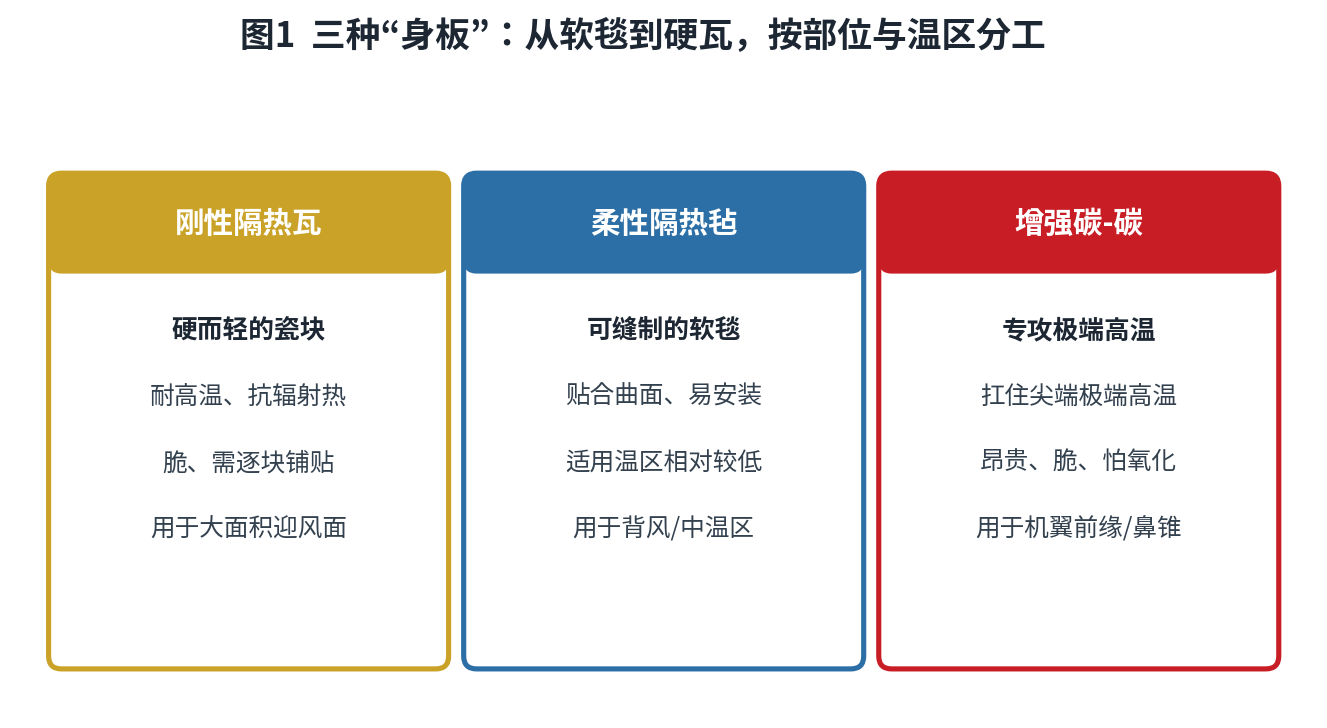
The final answer provided by NASA was a set ofThree distinct formsa "patchwork" thermal protection system composed of: rigid tiles, flexible blankets, and Toughened Uni-piece Fibrous Insulation (TUFI). Each component serves a specific function, covering the entire temperature range from 1600°C to 400°C across the vehicle, from nose cone to tail.
Insulation Tiles (LI-900 / LI-2200) – "Light as foam, hard as ceramic"
Refractory ceramic tiles are the signature material of the Space Shuttle's Thermal Protection System (TPS) and the most well-known. Their technical name isHigh-Purity Silica Fiber Insulation TilesSintered from 99.9% pure quartz glass fiber, it has an extremely low density (LI-900 is only about 0.14 g/cm³—lighter than cork)—yet can withstand surface temperatures up to 1260°C.
The working principle of insulating tiles is typicalBlock the heat: More than 90% of its internal structure consists of air pores, which trap heat within countless microscopic chambers and slow thermal conduction significantly. A thermal tile just a few centimeters thick can have an outer surface heated to 1200°C while the back remains cool enough to touch—often only a few dozen degrees.
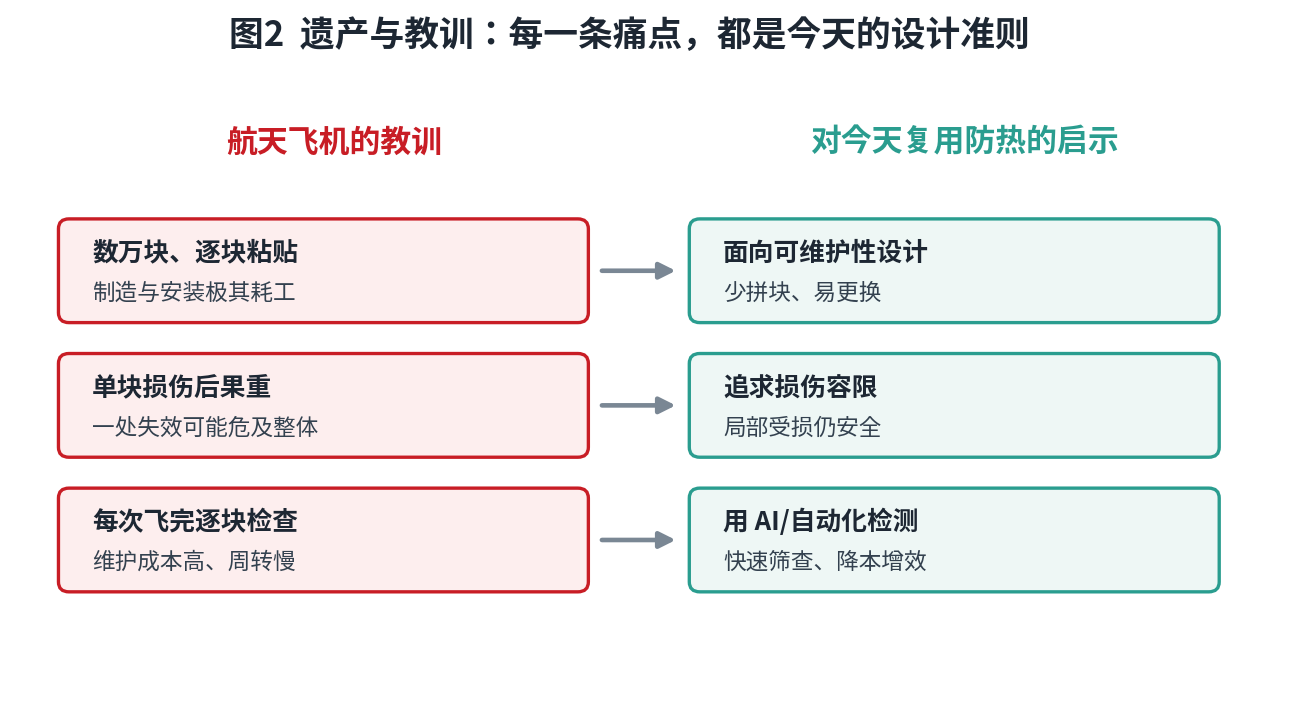
However, the heat shield tiles have a fatal weakness:CrispyIt resembles rigid foam plastic with extremely low tensile strength; it can easily crumble when squeezed by hand. Therefore, each tile is bonded to the aluminum airframe using specialized Stress Isolation Pads (SIPs) to absorb stresses caused by structural deformation and thermal expansion. Over 20,000 tiles cover the Space Shuttle's belly, each installed by hand and individually inspected.
Flexible Insulation Blanket (AFRSI / FRCI) – "Bendable Thermal Blanket"
In regions with lower temperatures (<650°C), NASA usedFlexible Insulation BlanketReplace bulky rigid tiles. AFRSI (Advanced Flexible Reusable Surface Insulation) is a flexible blanket made from a blend of alumina and silica fibers, encased in a white fabric cover.
The advantages of flexible felt includeBend, trim, and sewThis method offers significantly higher installation efficiency compared to individual tile bonding. It is suitable for areas with high curvature and moderate temperatures, such as the fuselage sides and payload bay doors. However, it has a lower maximum temperature rating and a softer surface that cannot withstand direct high-speed airflow erosion.
Rigid Tile (TUFI) — "Tougher Than Tile"
TUFI (Toughened Uni-piece Fibrous Insulation) is an enhanced version of thermal tiles. By incorporating reinforcement phases such as silicon carbide or alumina into a traditional silica fiber matrix, it improves the material'sSignificantly improved strength and toughness, while maintaining low density and excellent thermal insulation.
TUFI can be manufactured as larger monolithic components, reducing joint count and installation time. Its surface offers enhanced wear resistance and superior performance against aerodynamic scouring, making it ideal for areas like wing leading edges and vertical tails that require both thermal protection and structural strength. TUFI represents the evolution from "pure insulation" to integrated "insulation + load-bearing."
3. Reality: The Lessons of Columbia
On 2003, 2, 1, the Space Shuttle Columbia disintegrated during reentry, killing all seven astronauts. The final conclusion of the accident investigation pointed to a heartbreaking detail:A piece of foam insulation weighing only 1.7 lbs detached during takeoff and struck a carbon/carbon composite panel on the leading edge of the left wing.resulted in a hole approximately 25 centimeters in diameter.
On re-entry, hot gas above 1400℃ surged through the breach into the wing, melting aluminum alloy structural beams. This caused hydraulic system failure and disruption of the aerodynamic shape, ultimately leading to the aircraft breaking apart in mid-air.
This disaster exposed several deep-seated issues with the Space Shuttle's TPS:
- Vulnerability is underestimated: Although carbon/carbon panels withstand extremely high temperatures, they have limited impact resistance. Even a small piece of foam can cause fatal damage, indicating that the system's "safety margin" is far smaller than expected.
- Lack of in-orbit inspection capabilities: The crew could not effectively inspect the underside of the wings during the incident. NASA discussed on-orbit repair options but never implemented them.
- Organizational Culture Blind SpotsFoam shedding occurred multiple times during prior flights but was classified as an "acceptable anomaly" and not given sufficient attention. Technical risks were obscured by organizational inertia.
④ Challenge: The Inevitable Trade-off of Reusable Thermal Protection
The Space Shuttle's TPS was humanity's first attempt at "reusable thermal protection." It left behind not only a technical legacy but also a series of engineering contradictions that remain unresolved to this day:
- Light vs. StrongInsulation requires materials that are as lightweight and porous as possible; reusability demands materials that are strong and impact-resistant. These goals are inherently conflicting. Insulation tiles achieved extreme lightness but paid the price of fragility.
- Overall vs. ChunkedModular assembly facilitates replacing individual damaged blocks, but seams remain weak points where hot gases can leak through. Monolithic construction eliminates seams, yet any damage requires replacing a large section.
- Temperature Resistance vs. CostCarbon/carbon composites offer the highest heat resistance but come with high costs and long manufacturing lead times. Silica tiles are far more affordable but have a lower temperature limit. Balancing cost and performance is a key trade-off for every model.
- Design vs. OperationsThe TPS has a design life of 100 flights, but in reality, extensive inspections and repairs are required after each flight. Maintenance costs far exceeded expectations, which was one of the key reasons for the Space Shuttle's eventual retirement.
5. Tianyi's Perspective: From "Legacy" to "New Path"
The Space Shuttle's TPS is both a milestone and a mirror. It proved that reusable thermal protection is technically feasible, while also revealing the pitfalls along the way at a devastating cost.
When exploring next-generation thermal protection materials, Tianyi Quanan consistently uses lessons learned from the Space Shuttle program as a key reference:
- Non-ablation is the prerequisite for reusability.Ablative materials are single-use and cannot support true reusability. Our pioneering Pre-Ceramic Hybrid Engine Coating (PHEC) is designed to remain non-consumable, dimensionally stable, and reusable under extreme temperatures.
- Resilience matters more than temperature resistance.The Columbia disaster taught us that materials must not only withstand heat but also endure unexpected impacts. PHEC coatings are engineered for both impact resistance and thermal shock tolerance, preventing a repeat of the fragile tile failures seen in the past.
- Systematic thinkingNo single material can solve every problem. Tianyi Quan'an takes a holistic approach, designing and validating the coating, thermal insulation, and structural layers as an integrated system. The entire assembly is evaluated using "heat flux–time" curves to assess real-world performance.
- Trustworthy when verifiableThe tragedy of the space shuttle stemmed partly from assuming things were fine rather than proving they were. We insist on subjecting every material to extreme ground-based tests—such as oxyacetylene flames and arc wind tunnels—to clearly define its performance limits and let the data speak.
We believe the Space Shuttle's greatest legacy is not a specific material, but a mindset:Reusable thermal protection is a viable path, but it must be pursued with respect for the risks and a commitment to data integrity.This journey continues at Tianyi Quan'an.
⑥ Further Reading · Test Consultation
In-site Extensions:
- → Material Map: Comprehensive Overview of Thermal Protection Materials
- → Ablative materialsA classical survival strategy: sacrifice yourself.
- → Ceramic Fiber and Nano-Insulation Blanket: Cage the air
- → aerogel: The World's Lightest Solid: Why It Didn't Dominate the Market
Consultation Test
Interested in reusable thermal protection materials? Contact Tianyi Extreme Environment Laboratory to learn about our latest advancements and collaboration opportunities in non-ablative coatings and integrated thermal protection systems.