
Material Map: Comprehensive Overview of Thermal Protection Materials

Thermal protection materials form a diverse family, each with distinct strategies for managing heat: some sacrifice themselves, others block, some dissipate, and a few do it all.
The Four Major Families of Thermal Protection Materials
Thermal protection materials aren't a one-size-fits-all solution. Based on their heat-handling mechanisms, they fall into four distinct families—each with its own strengths and quirks.
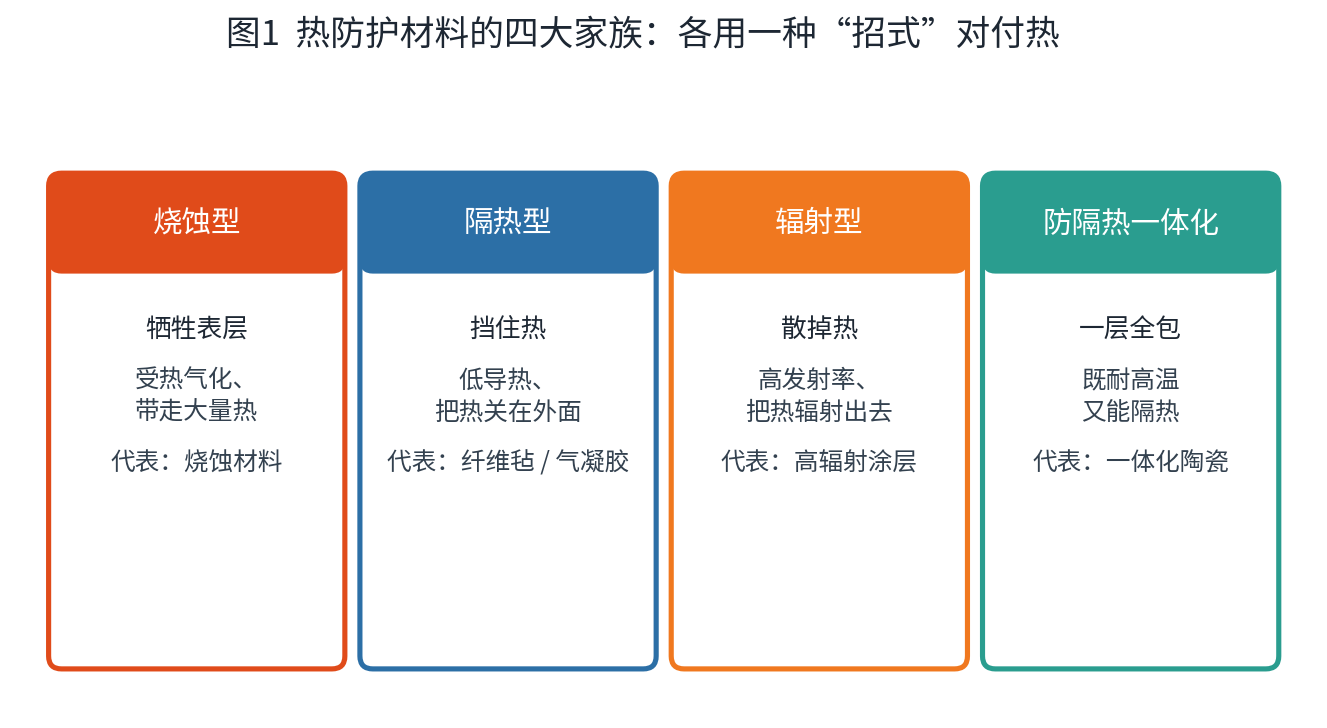
Four families of thermal protection materials in Figure 1: each uses a unique approach to combat heat.
Ablative: Sacrifices the surface layer to dissipate heat.
Ablative materials are the most sacrificial of all. When exposed to extreme heat, they don't just resist—they actively "sacrifice" themselves: their surface decomposes, vaporizes, or melts, carrying away vast amounts of heat through phase change. Like firefighters using water to extinguish flames—where evaporation absorbs heat and puts out the fire—ablative materials ensure the safety of the structure behind them by giving up their own integrity.
Typical examples: phenolic resin-based composites, carbon/carbon composites, and silicone-modified epoxy ablation coatings.
Application: Short-duration, extremely high heat flux scenarios (e.g., rocket re-entry, engine nozzles), with heat flux densities reaching several kW/m² but brief duration.
Insulated: Low thermal conductivity keeps heat out.
Insulation works by blocking heat. Typically porous, loose, and low-density, it traps non-conductive air in countless tiny pores to slow heat transfer significantly. While these materials may not withstand high temperatures themselves, they keep the structure behind them cool.
Typical examples: aerogel blankets, ceramic fiber blankets, nano-insulation boards, and composite aerogel thermal protection materials.
Application: Long-duration, high-temperature insulation (e.g., launch vehicle skin panels, external tank thermal protection) under low but sustained heat flux.
Radiative: High emissivity, active cooling
Radiative materials rely on "emission." At high temperatures, they exhibit high emissivity, re-radiating absorbed heat as infrared radiation to lower their own temperature. This is similar to wearing light-colored clothes in summer instead of dark ones—lighter surfaces reflect or emit more thermal radiation.
Typical examples include high-emissivity ceramic coatings, self-radiative cooling coatings, and aerospace self-radiative coatings (e.g., ZrSi-SR107-TR).
Application scenarios: high-temperature, long-term service and active cooling requirements (e.g., leading edges of aerospace vehicles, hot-section engine components).
Integrated heat and fire protection: Resists high temperatures while providing thermal insulation.
Some materials go beyond a single function, offering insulation, high-temperature resistance, erosion protection, and radiative control all at once. These are typically composite structures or multi-functional coatings designed to deliver multiple layers of performance in one.
Typical examples: precursor-based ceramic (PHEC) ablation-resistant coatings, ceramic matrix composites (CMCs), and ultra-thin expandable anti-ablation coatings.
Application scenarios: extreme combined operating conditions (e.g., reusable launch vehicles, hypersonic vehicles) requiring high-temperature resistance, erosion protection, lightweight design, and reusability.
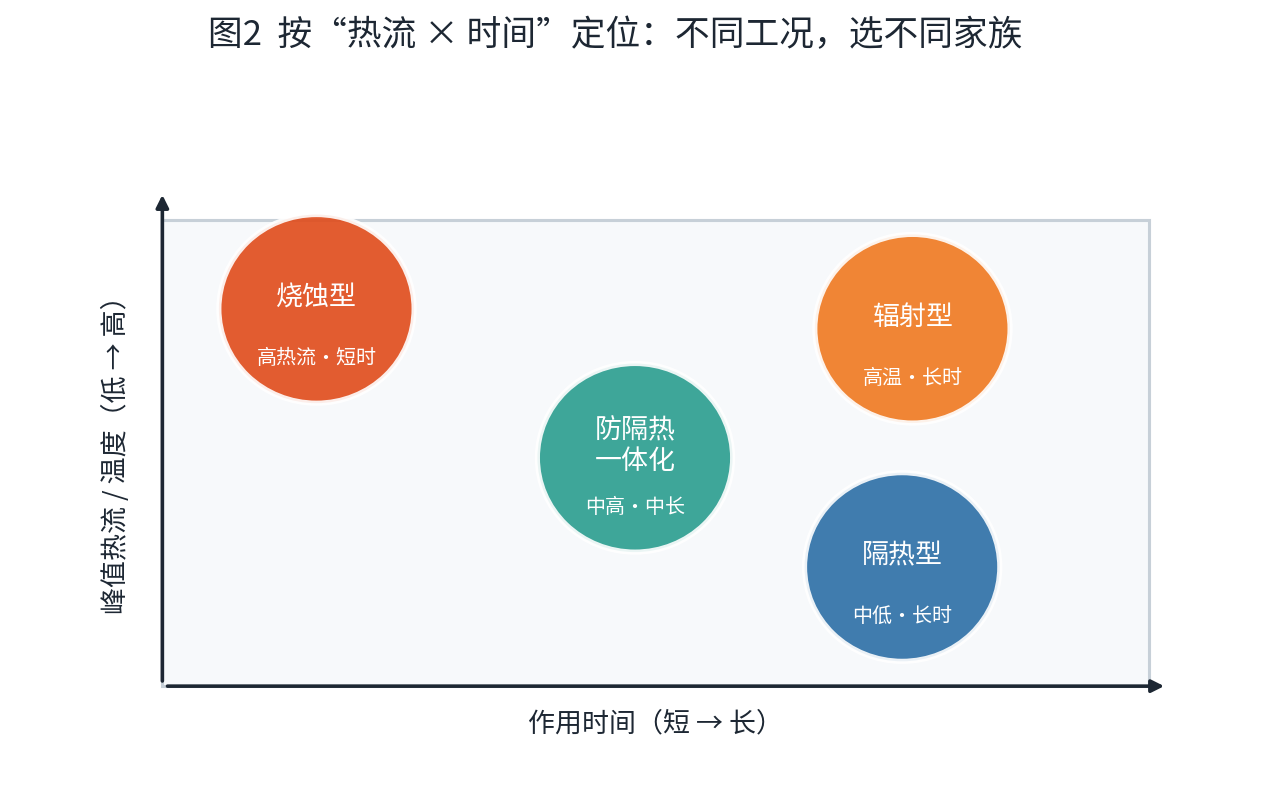
Figure 2 Locates by "Heat Flow × Time": Choose the appropriate family for different operating conditions.
How to Select the Right Material Family
There is no absolute best or worst among the four major families; it's all about fit. The key to selection is laying out these factors: heat flow magnitude, duration, peak temperature, reusability, and weight constraints—then matching them accordingly.
- Short-duration extreme heat fluxFor (millisecond-level, thousands of kW/m²): Ablative is the preferred choice—sacrificing material to ensure safety.
- High heat flux over extended duration(Few minutes, hundreds of kW/m²) → Primarily insulated type with heat-resistant outer layer.
- High temperature + long duration; active cooling required→ Essential for radiative or radiative control coatings.
- Extreme comprehensive operating conditions + Reusable→ The only solution is an integrated/multi-functional approach, such as PHEC coating.
In reality, scenarios involving only ablation, only insulation, or only radiation are rare. Most thermal protection systems (TPS) employ a hybrid approach: the outer layer uses erosion-resistant materials to withstand convective and radiative heating; an intermediate insulation layer blocks heat conduction; and surface radiation control dissipates excess heat. Effective thermal protection isn't about relying on a single material for all conditions—it's about using the right material at the right location.