
Polymer-Derived Ceramics (PDC)
Chemical magic: from polymers to ceramics
② Common Knowledge: What is PDC? Making ceramic from plastic.
When people think of ceramics, they often picture inorganic materials that are fired at high temperatures—hard yet brittle. ButPolymer-Derived Ceramics (PDC)Shattered that preconception: it doesn't start with powder, but rather with aLiquid or solid organic polymersThrough a precise thermochemical conversion process, this "plastic" transforms into a high-performance ceramic capable of withstanding temperatures exceeding 1600°C.
This process is like a chemical magic trick: the raw material is a soft, moldable polymer, and the final product is a hard, heat-resistant ceramic. The bridge in between is a set of processes known asPolymer precursor methodprocess route.
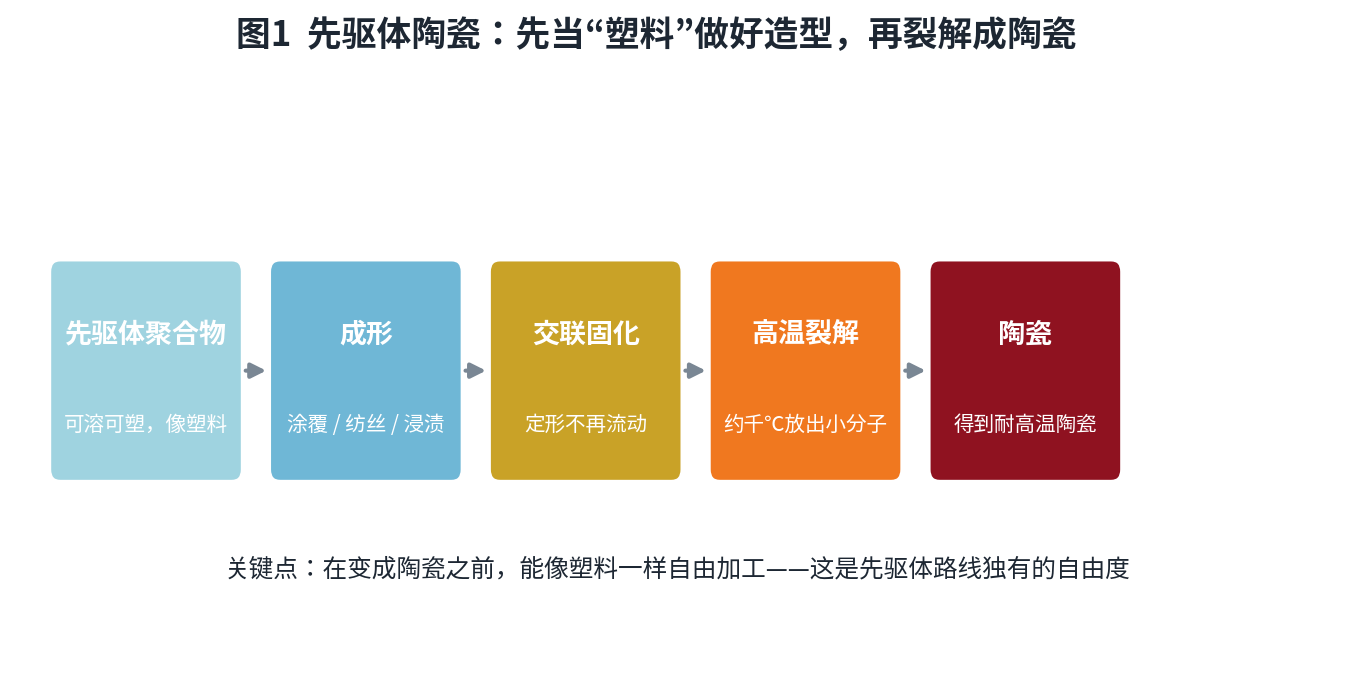
PDC's Three-Step Conversion
- Step 1: Synthesis and MoldingDissolve or melt organic polymers containing elements such as silicon, carbon, and nitrogen (e.g., polycarbosilane [PCS], polysilazane [PSZ], and polysilsesquioxane [PSO]), then shape them via coating, impregnation, spinning, or 3D printing. This step leverages the processability of polymers to achieve complex geometries that are difficult or impossible with traditional ceramic powder methods.
- Step 2: Cross-linking and CuringThermally cure or radiation-crosslink the shaped polymer at 200~400°C to convert it from a thermoplastic to a thermoset network. This step is critical: insufficient crosslinking can cause the material to soften, deform, or even melt and be lost during subsequent high-temperature pyrolysis.
- Step 3: High-temperature pyrolysis (ceramization)Heat the cross-linked polymer in an inert atmosphere to 1000~1600°C. The organic components gradually decompose and are removed, while the remaining Si, C, N, and other elements recombine to form amorphous or nanocrystalline ceramics. This pyrolysis step involves a mass loss of approximately 30%~50% and a volume shrinkage of 20%~40%, making it a critical stage that must be precisely controlled in the PDC process.
These three conversion steps give PDC a unique advantage:Combines the processability of polymers with the high-temperature resistance of ceramics.This is something traditional powder sintering ceramics cannot achieve.
3. Reality: What Can PDC Do?
After decades of development, PDC has evolved from laboratory research to engineering applications, resulting in multiple product forms and application directions:
PDC Coating
Polymer precursor solutions are coated onto substrates and, after crosslinking and pyrolysis, form dense ceramic thin films. Coating thickness ranges from a few micrometers to hundreds of micrometers, and composition can be precisely tuned through molecular design of the precursors. Typical applications include environmental barrier coatings for CMC components, oxidation-resistant protection layers on metal substrates, and non-ablative thermal protection systems for spacecraft. The polymer-derived (PHEC) ceramic coatings explored by Tianyi Quan'an fall into this category, maintaining non-ablative performance under thermal shock up to 2200°C.
PDC Fiber
Continuous ceramic fibers are produced by melt-spinning polymer precursors followed by crosslinking and pyrolysis. SiC fibers (e.g., Nicalon, Hi-Nicalon, Tyranno series) serve as the core reinforcement in CMCs, directly determining their mechanical limits. Third-generation near-stoichiometric SiC fibers achieve tensile strengths of 2.5~3.0 GPa, elastic moduli exceeding 400 GPa, and thermal stability above 1400°C.
PDC Matrix and Composites
Leveraging the low viscosity and excellent wettability of polymer precursors, the PIP process fills pores in fiber preforms through repeated impregnation-pyrolysis cycles to progressively densify and form a CMC matrix. Compared to CVI, PIP offers lower equipment costs, shorter cycle times, and easier fabrication of large-scale components as a single piece.
PDC Micro/Nano Structures and Functional Devices
Using microfabrication techniques such as lithography, 3D printing, and soft mold casting, PDC can create complex 3D microstructures that traditional ceramic processes cannot achieve, including MEMS sensors, micro-combustors, and photonic crystals. These devices operate in extreme environments like high temperatures and corrosive conditions, expanding the functional limits of ceramics.
④ Challenge: Bridging the gap from lab to engineering
The principle behind PDC is elegant, but there are several unavoidable challenges in transitioning from laboratory samples to reliable engineering products:
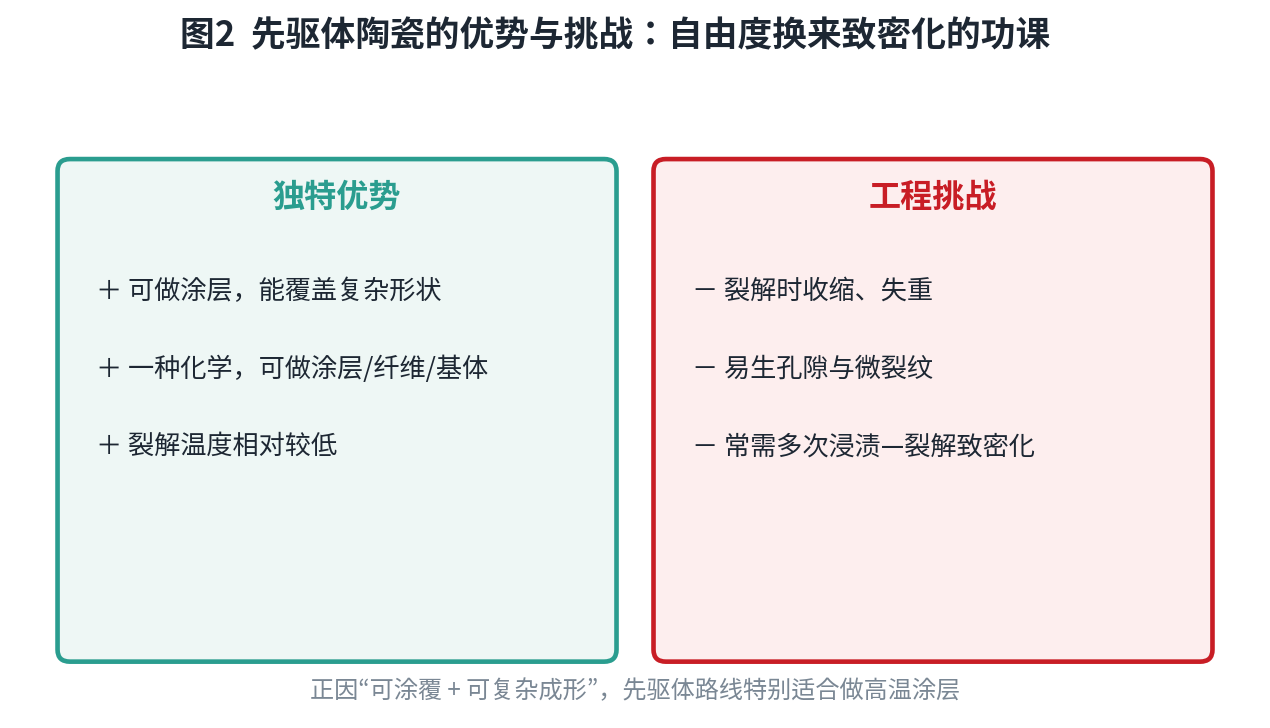
- Cracking and shrinkageA mass loss of 30%~50% and a volume shrinkage of 20%~40% result in significant internal stress. If the heating rate is too fast or the component cross-section is too thick, cracks or even fragmentation can easily occur. In engineering practice, multiple "impregnation-pyrolysis" cycles are typically required to gradually fill pores and relieve stress, which increases process cycle time and cost.
- Batch ConsistencyThe final performance of PDCs is highly dependent on precursor parameters such as molecular weight distribution, crosslinking degree, and pyrolysis temperature profiles. Minor variations between precursor batches can be amplified during pyrolysis, causing fluctuations in the composition, density, and mechanical properties of the resulting ceramics. Establishing rigorous quality control measures and defined process windows is essential for industrialization.
- Long-term thermal stabilityPDC ceramics are typically amorphous or nanocrystalline within the 1000~1400°C range. Prolonged exposure to high temperatures can induce crystallization, phase transformation, or oxidation, leading to performance degradation. For aircraft engine components requiring thousands of hours of service life, this is one of the major barriers to certification.
- Cost and ScalabilityThe synthesis of high-performance polymer precursors (e.g., high-purity PCS, PSZ) is costly, and the pyrolysis process requires prolonged high-temperature treatment under inert atmospheres. Compared to traditional powder metallurgy ceramics, PDCs still carry a higher unit cost. Reducing costs and improving yield are critical to transitioning from "high-end custom" production to "mass supply."
- Lack of design and validation frameworkThe microstructure of PDC ceramics (a mixed amorphous/nanocrystalline state) differs fundamentally from that of conventional sintered ceramics, rendering existing design codes and failure models for sintered materials inapplicable. Establishing dedicated material databases, design guidelines, and certification standards for PDC is a shared industry challenge.
⑤ Tianyi Perspective: PDC Is the Bridge to "Non-Ablative Thermal Protection"
Tianyi Quan'an regards the precursor ceramic asCore technical route to achieve the "ultra-high temperature + non-ablative + reusable" thermal protection goal。
While traditional ablative materials are efficient, they are single-use and non-reusable; while traditional thermal protection materials are lightweight, they fail under extreme thermal shock. PDC's unique value lies in its ability to maintain ceramic-grade temperature resistance through molecular design and process control, while offering flexibility that traditional ceramics lack.Resilience, processability, and compositional flexibility。
What Tianyi Quan'an is exploringPrecursor-derived Ceramic (PHEC) Coating, is the engineering application of PDC technology in the field of thermal protection:
- Non-ablativeUndergoes no significant mass loss and maintains thickness under 2200℃ thermal shock, theoretically enabling multiple reuses.
- Customizable ingredientsBy adjusting precursor molecular structures and filler ratios, coating properties such as heat resistance, oxidation resistance, and radiation control can be tailored to specific thermal environments.
- Excellent process compatibilityCan be applied via spraying, brushing, or dipping. Suitable for substrates of various shapes and sizes; can form multi-layer thermal protection systems with materials such as CMCs and thermal insulation blankets.
We believe PDC is not meant to replace all traditional ceramics, but ratherCreate new opportunities where traditional ceramics fall shortFor applications requiring complex geometries, extreme temperature resistance, non-ablative performance, and reusability, PDC is the ideal solution. This journey from polymer to ceramic is exactly where Tianyi Quanan is heading.
⑥ Further Reading · Test Consultation
In-site Extensions:
- → Material Map: Comprehensive Overview of Thermal Protection Materials
- → Ceramic Matrix Composites (CMC)The Temperature Ceiling of Aircraft Engines
- → Thermal Barrier Coating (TBC)The Value of 200 Microns on the Blade
- → Ablative materialsA classical survival strategy: sacrifice yourself.
Consultation Test
Not sure if your operating conditions suit the PDC/PHEC solution? Contact Tianyi Extreme Environment Lab for a thermal environment assessment and recommendations on matching precursor ceramic materials and system design.