
Nozzle and Combustion Chamber: Materials Science Under Extreme Heat Flux

If re-entry heating comes from the outside, a rocket engine carries its own "hell" inside. The combustion chamber and nozzle walls must withstand gases at thousands of degrees, extreme pressure, and high velocity—making them some of the most thermally stressed components in aerospace engineering.
Fact: The throat is the "hotspot" where heat flow is most concentrated.
If re-entry heating comes from the outside, a rocket engine carries "hell" within. Its combustion chamber and nozzle walls face gas at thousands of degrees, high pressure, and extreme velocity—among the most intense heat fluxes in aerospace. The materials science here pushes engineering to its limits.
Hot spot in nozzle of Figure 1: The throat must withstand extremely high heat flux and scouring by high-speed exhaust gas.
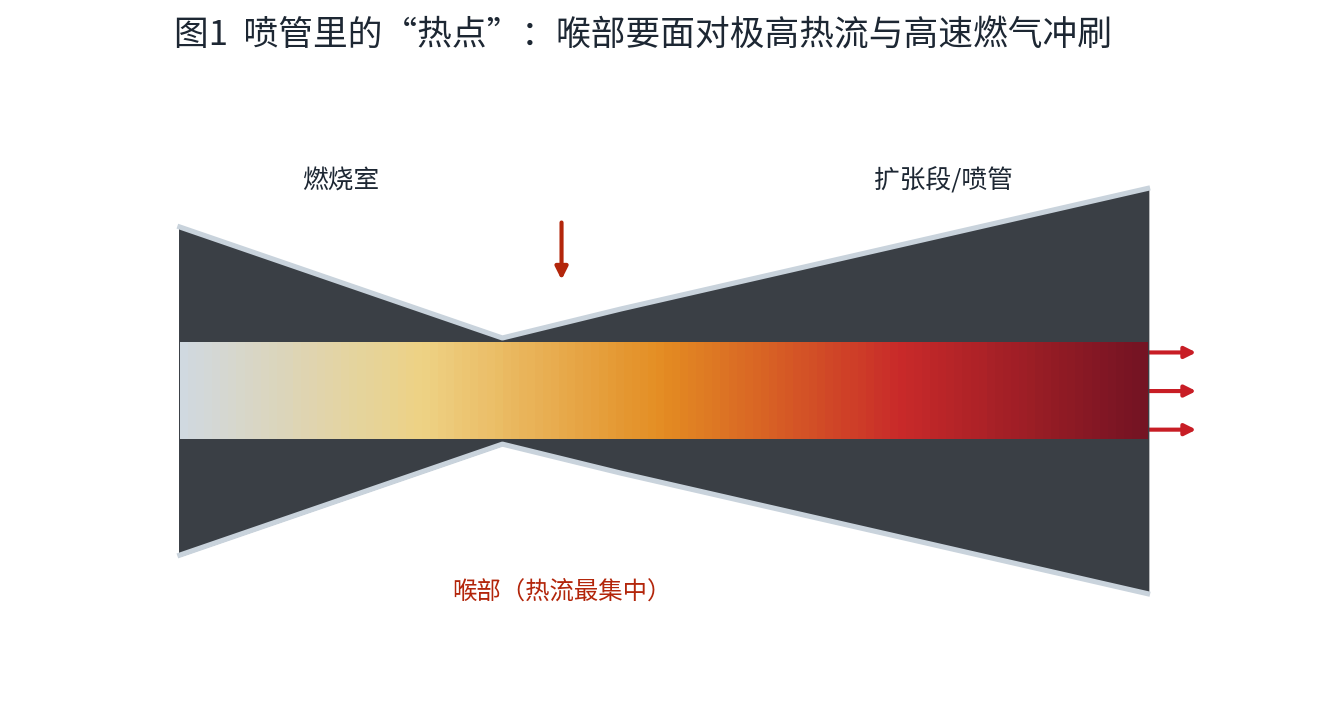
Hot spots in nozzle 1: The throat endures extreme heat flux and high-speed erosion simultaneously.
In the combustion chamber, fuel ignites and accelerates through a converging "throat," then exits at high speed via an expanding section. The throat has the smallest cross-section, where gas density and velocity peak, concentrating intense heat flux while enduring continuous erosion from high-speed gases. This is the most severe thermal environment in the entire engine.
Three approaches: active cooling, sacrificial ablation, and passive heat resistance—each with trade-offs.
Figure 2: Three approaches—active cooling, sacrificial ablation, and passive heat resistance—each involve trade-offs.

Figure 2: Three mitigation strategies: active cooling, sacrificial ablation, and passive thermal resistance.
Faced with extreme heat flux, engineers have three options: regenerative cooling, where fuel flows through the wall to carry away heat—high performance but complex structure; ablative lining, which uses sacrificial inner layers to dissipate heat—simple and reliable but single-use; and passive thermal resistance, employing high-temperature ceramics or coatings to withstand heat directly—enabling reusability but demanding precise thermal matching and erosion resistance. There is no universal solution; only trade-offs tailored to specific operating conditions.
The triple challenge of heat, force, and chemistry
Nozzle materials must withstand three simultaneous challenges: extreme temperatures, mechanical loads from high-speed flow, and chemical erosion (oxidation, ablation) by combustion gases. Meeting all three under strict weight constraints—and enduring repeated cycles in reusable applications—represents an exceptionally demanding test of material performance.
Tianyi Perspective: The Value and Validation of the Passive Thermal Resistance Approach
As reuse demands rise, heat-resistant coatings that can withstand high heat fluxes passively and are easy to repair are gaining attention. Tianyi Quan'an focuses on balancing erosion resistance, oxidation resistance, and thermal matching in precursor-derived ceramic coatings. Ground-based high heat flux tests validate performance under near-real conditions—ultimate material limits must be backed by data.
Read More · Test Consultation
In-site Extensions:
- → Polymer-Derived Ceramics (PDC): The Chemical Magic Transforming "Polymers" into "Ceramics"
- → Ceramic Matrix Composites (CMC): The Temperature Ceiling for Jet Engines
- → Oxy-acetyrene Ablation, Quartz Lamp Irradiation, Laser Heating: What Can Each Measure?
Consultation TestInterested in temperature resistance and erosion validation under extreme heat flux? Contact Tianyi Extreme Environment Laboratory.