
Tianyi Quan'an's two self-developed lightweight heat-resistant materials successfully passed the joint extreme thermal environment assessment under "Yan Jia-2026".
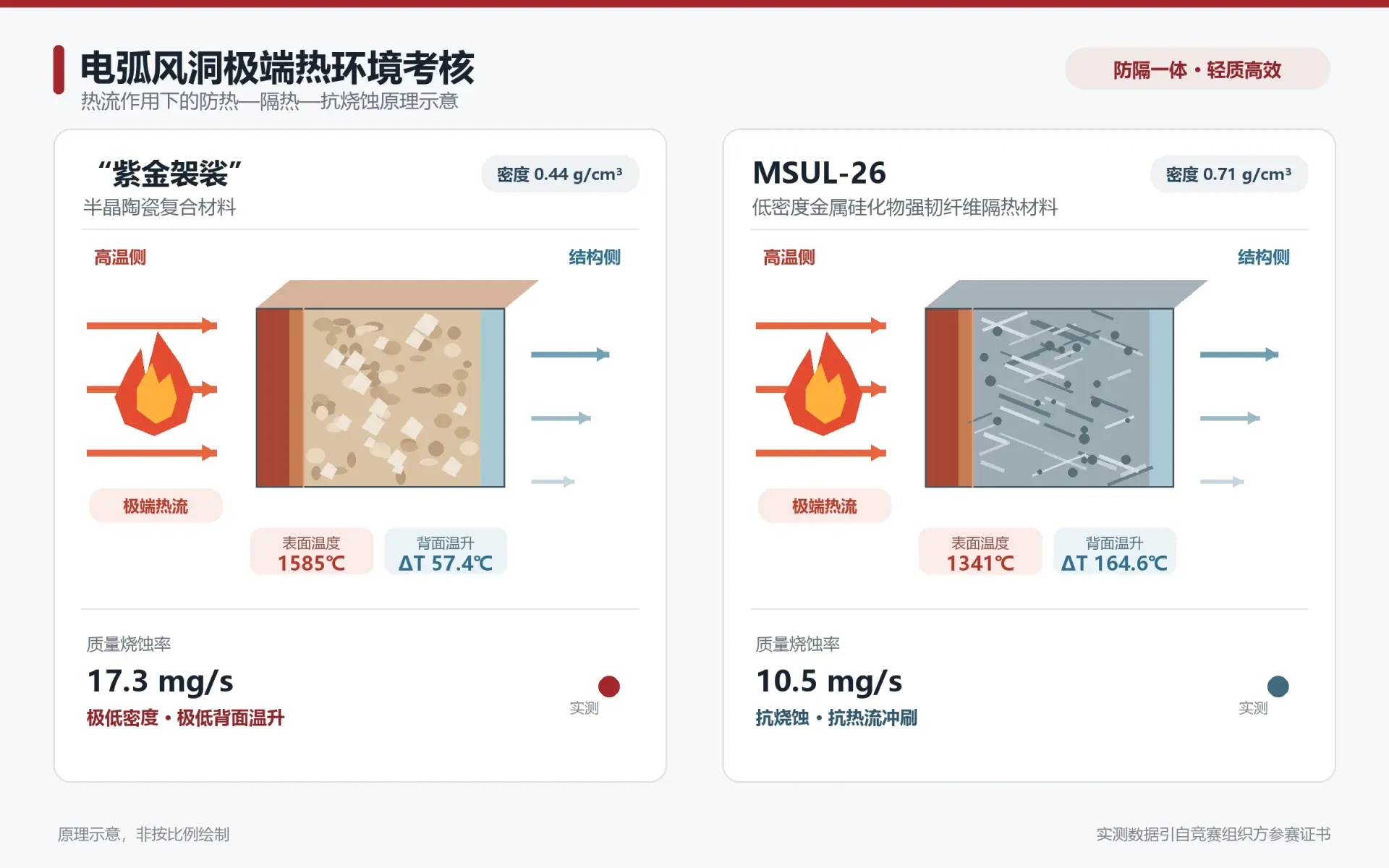
Tianyi Quan'an (Shanghai) Technology Co., Ltd. and Shanghai Jiao Tong University jointly submitted the "Zijin Karaka" semi-crystalline ceramic composite material and MSUL-26 low-density metal silicide toughened fiber insulation material. Both materials met the "Status 2" endurance level during the extreme thermal environment assessment of the "Yanjia-2026" thermal protection material competition using an arc wind tunnel, and received official participation certificates issued by the competition organizers.
"FlameShell-2026" Thermal Protection Material Competition: Participant Insights
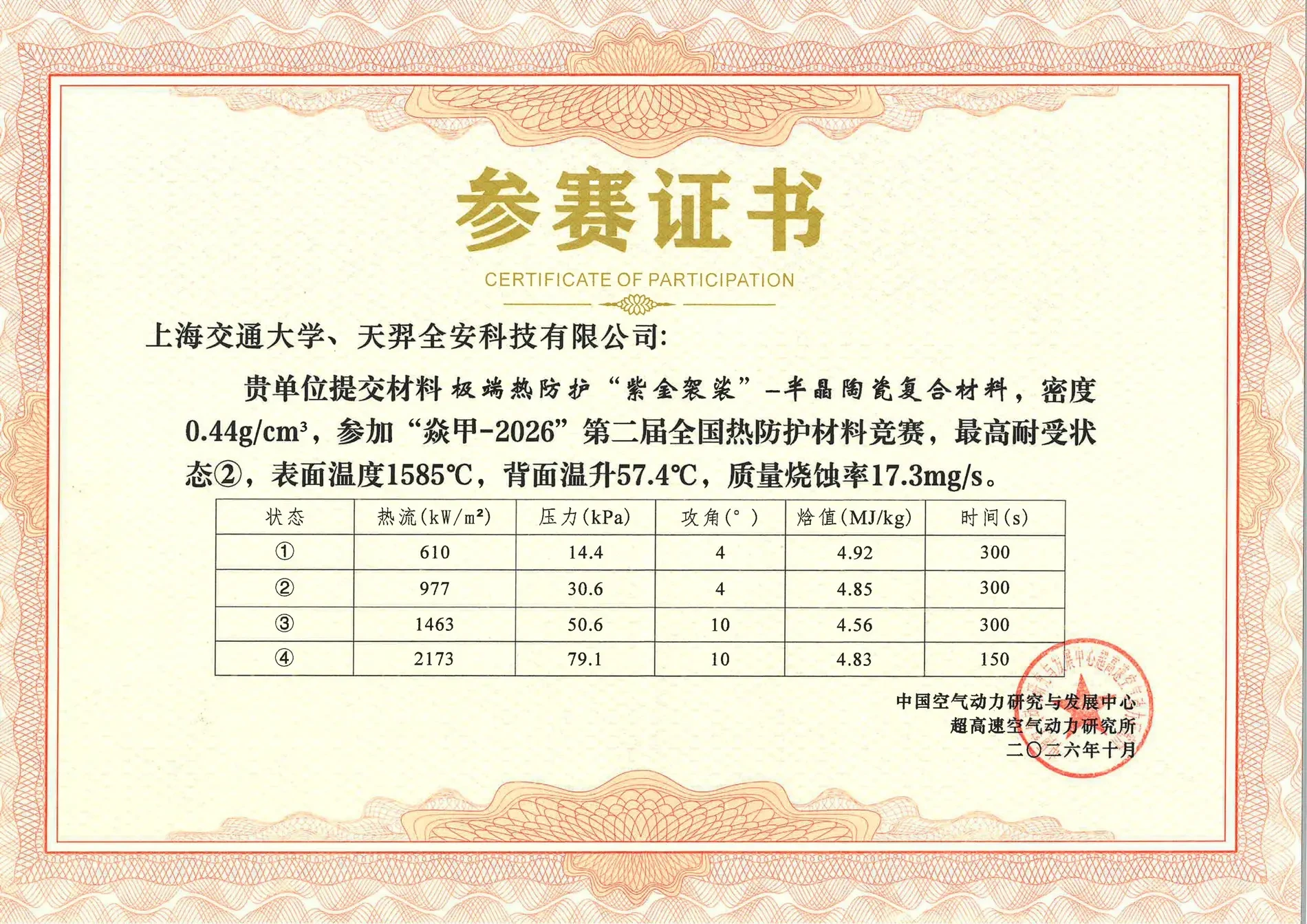
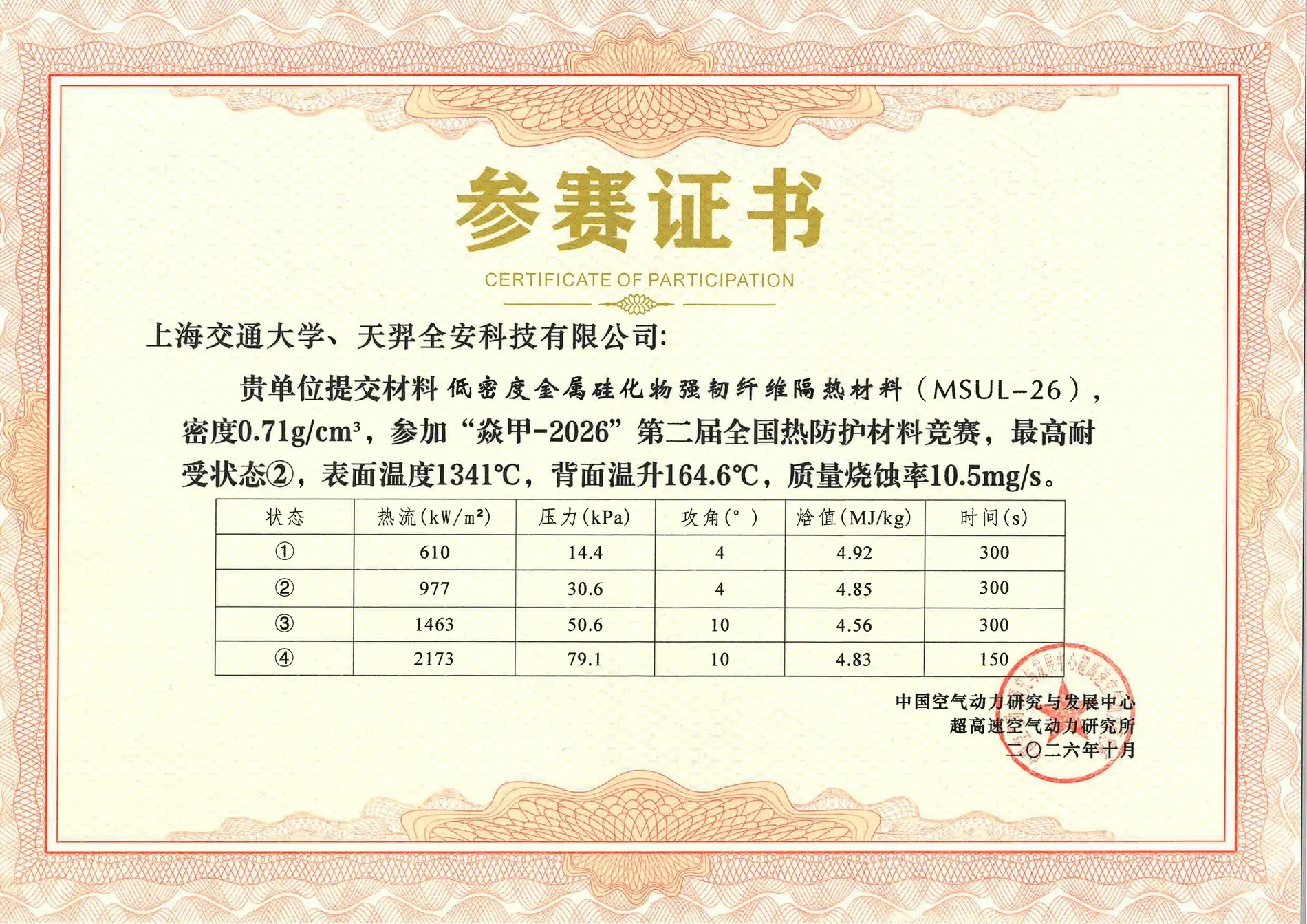
Recently, the results of the "Yanjia-2026" Thermal Protection Material Competition were confirmed by the organizers, and participation certificates were issued. Tianyi Quan'an (Shanghai) Technology Co., Ltd. and Shanghai Jiao Tong University jointly submitted two self-developed lightweight thermal insulation materials: the extreme thermal protection "Zijin Kasaya" semi-crystalline ceramic composite material and the low-density metal silicide toughened fiber insulation material (MSUL-26). Both materials achieved "Status 2" tolerance levels during arc wind tunnel testing under extreme thermal conditions, earning excellent results. The two participation certificates were issued by the Hypervelocity Aerodynamics Institute of the China Aerodynamics Research and Development Center in 2026 year, 10 month. The measured data recorded on the certificates confirm the tolerance status, surface temperature, back-side temperature rise, and mass ablation rate achieved by each sample.
The "Yanjia" series of competitions was launched by the Key Laboratory of Flight Vehicle Fluid Physics in collaboration with 18 leading domestic innovation platforms and established in 2023. This year's competition, themed "Integrated Protection and Lightweight Efficiency," addresses the need to enhance performance in large-area thermal protection zones of new high-speed aircraft under long-duration, high-temperature, oxygen-rich service conditions. It focuses on selecting high-quality, practical lightweight thermal insulation materials, bringing together 76 material R&D units and top enterprises, along with 97 research teams for competition. The opening ceremony was held on 2026/7/5 in Mianyang, Sichuan, after which participating samples underwent extreme thermal environment testing using the host's arc wind tunnel facilities.
Two technical approaches, one set of complementary data.
The two samples submitted by Tianyi Quan'an follow distinct technical approaches, and the evaluation results demonstrate clear complementarity.
The "Purple-Gold Kasaya" semi-crystalline ceramic composite has a density of only 0.44 g/cm³. During testing, the surface temperature reached 1585°C while the backside temperature rise was just 57.4°C, with a mass ablation rate of 17.3 mg/s. Achieving both ultra-low density and minimal backside heating demonstrates that the material effectively limits heat transfer to the structure side even under peak aerodynamic heating—this is a critical metric for system weight reduction in large-area thermal protection zones.
MSUL-26 low-density metal silicide toughened fiber insulation material with a density of 0.71 g/cm³. During testing, the surface temperature reached 1341°C, the backside temperature rise was 164.6°C, and the mass ablation rate was 10.5 mg/s. The reduced ablation loss highlights the advantages of the metal silicide system combined with fiber reinforcement in resisting ablation and thermal flow erosion, offering an alternative technical solution for maintaining material integrity.
According to the company, beyond their performance differences, both products share a unified engineering positioning: they are low-cost, rapidly deployable, and repairable coating materials designed for ultra-large-area thermal protection. They can be fabricated and applied around the extensive heat-shield zones of commercial spacecraft. This positioning balances material performance, construction efficiency, and overall cost, helping to shorten deployment cycles while providing the necessary material support for the commercial aerospace industry's demand for lightweight, scalable, and batch-produced thermal protection solutions.
Completed the full cycle from formula development to extreme-environment testing in its founding year.
The simultaneous submission of two prototype samples and their successful passage through the same durability test level demonstrates that, within its first year of establishment, the company completed a full-chain validation—from material formulation and sample fabrication to third-party extreme thermal environment testing. This technical foundation stems from research conducted by the School of Materials Science and Engineering at Shanghai Jiao Tong University, with Tianyi Quanan driving its engineering implementation and industrialization. For a technology enterprise that was officially registered in 2026 4, obtaining such empirical data on professional extreme thermal environment testing equipment provides a solid basis for future material selection and engineering validation aligned with specific program requirements.
The company stated that it will use the test data from this competition as a starting point to continue iterating formulations and optimizing processes for both materials under more stringent operating conditions, advancing the engineering application of lightweight thermal protection materials in commercial aerospace and extreme thermal defense sectors.
About Tianyi Quan'an
Tianyi Quan'an (Shanghai) Technology Co., Ltd. was founded in 2026, registered in Minhang District, Shanghai. As a thermal protection technology enterprise dedicated to the demanding aerospace environment, we have built an integrated capability system centered on three key areas: advanced thermal protection materials, extreme thermal environment simulation equipment, and intelligent inspection. We provide thermal protection materials and solutions for high-speed vehicles and high-performance equipment.
Note: Material names, densities, and assessment data in this document are sourced from the competition certificates issued by the organizing body. Competition details are subject to official statements from the organizers. Unauthorized reproduction is prohibited.
Technical Cooperation Inquiry
Interested in the content or want to learn more? Contact us.
Get Started