
Dense launch windows open: China's space program enters a high-frequency, airline-like cadence
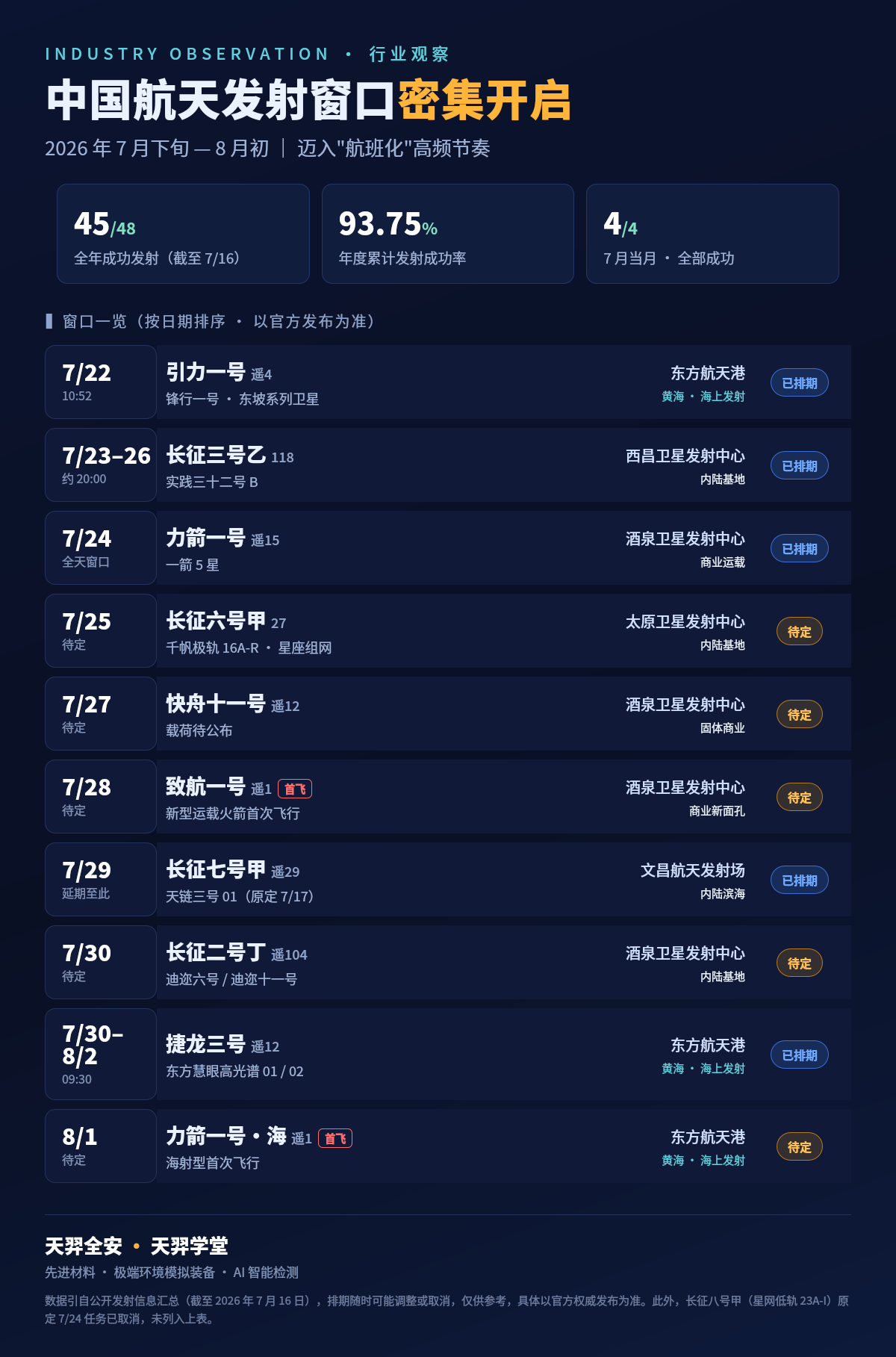
In late January of 2026, China's space launch activities entered a dense window, achieving 4 successes out of 4 missions this month. Over ten launches are scheduled or pending from mid-to-late 7 through early 8. Launch sites are active across multiple locations, with national teams and commercial players launching together. The demand for satellite constellation deployment has made high-frequency launches the new normal.
More than 10 launches in a month; the "peak period" begins in late 7.
As 2026 enters its late 7, China's space launch activity is entering another high-intensity window. According to publicly available launch data, as of 7 16, the country has completed 45 successful launches out of 48 total missions this year, with a success rate of approximately 93.75%. In 7 alone, there were 4 consecutive successful launches. From mid-to-late 7 through early 8, more than ten launches are either scheduled or pending—nearly one rocket per day.
Launch characteristics based on the public schedule
This launch is characterized by three distinct features:
- Multiple launch sites in actionTasks are distributed across traditional launch sites in Wenchang, Xichang, Jiuquan, and Taiyuan. The Hainan Commercial Aerospace Launch Site continues to support high-density constellation launches, while the "Sea Launch" platform at the Dongfang Spaceport in the Yellow Sea has also made multiple appearances.
- State-backed teams and commercial forces share the stage.While the Long March series remains the workhorse, commercial launch vehicles such as i-Space's Gravitational-1, LinkSpace's Lijian-1, CASC's Jielong-3, and Kuaizhou have made their debut. Several new rocket models are reaching their maiden flight milestones, and sea-launched variants are also entering initial flight verification.
- Network requirements drive high-frequency usage.Batch satellite internet constellation missions, led by projects such as StarNet and Qianfan, are entering a scale-up phase. "Scheduled flights, high frequency, and low cost" are evolving from vision to necessity.
From "Can Fly" to "Affordable and Reliable"
Industry observers widely consider 2026 a landmark year for China's commercial space sector, as the competitive logic undergoes a fundamental shift: from proving orbital insertion capability to focusing on engineering delivery and cost control. With mass production ramping up for satellite constellations comprising tens of thousands of units, next-generation launch vehicles are converging on common goals: payload capacity exceeding 7 tons, reusability, and airline-like launch cadence.
High-frequency, reusable operations demand stricter engineering standards. During launch, re-entry, and multiple reuse cycles, rocket airframes, engines, and thermal protection components must withstand repeated extreme heat, thermal shock, and thermo-mechanical coupling stresses. Satellites and payloads face similar long-term exposure to the space thermal environment. The higher the launch frequency and reuse rate, the greater the requirements for consistency, reliability, and verifiability of thermal protection systems and materials capable of withstanding extreme conditions.
Materials and Testing: The Invisible Foundation of the High-Frequency Transmission Era
In this round of industrial upgrading focused on cost reduction, output increase, and reliability enhancement, advanced thermal protection materials, extreme environment simulation testing, and intelligent inspection capabilities are becoming the invisible foundation supporting orbital launch operations.
Tianyi Quanan (Shanghai) Technology Co., Ltd. is positioned in this sector. Anchored by its core technology of rare-earth high-entropy polysilane ceramic precursors (PHEC) for thermal protection—a breakthrough developed through years of research by Prof. Guo Fangwei's team at the School of Materials Science and Engineering, Shanghai Jiao Tong University—the company has established an integrated strategy spanning "advanced materials," "extreme environment simulation equipment," and "AI-powered inspection." We are dedicated to providing material solutions and validation support for aerospace and other high-end equipment operating in extreme thermal environments.
A dense launch schedule is a clear indicator of China's space program moving toward scale and commercialization. While we look up in awe at every liftoff, we will also continue to deepen our expertise in materials and inspection—the "invisible foundation"—and work with industry partners to ensure the steady progress of these national strategic assets.
Industry data in this article is sourced from publicly issued information summaries; specific details are subject to official authoritative releases. Technical descriptions provided here are for illustrative purposes only and reflect industry trends.
Technical Cooperation Inquiry
Interested in the content or want to learn more? Contact us.
Get Started