
From a pinch of powder to complex ceramic components: What does UHS's "one-step reactive sintering" mean?
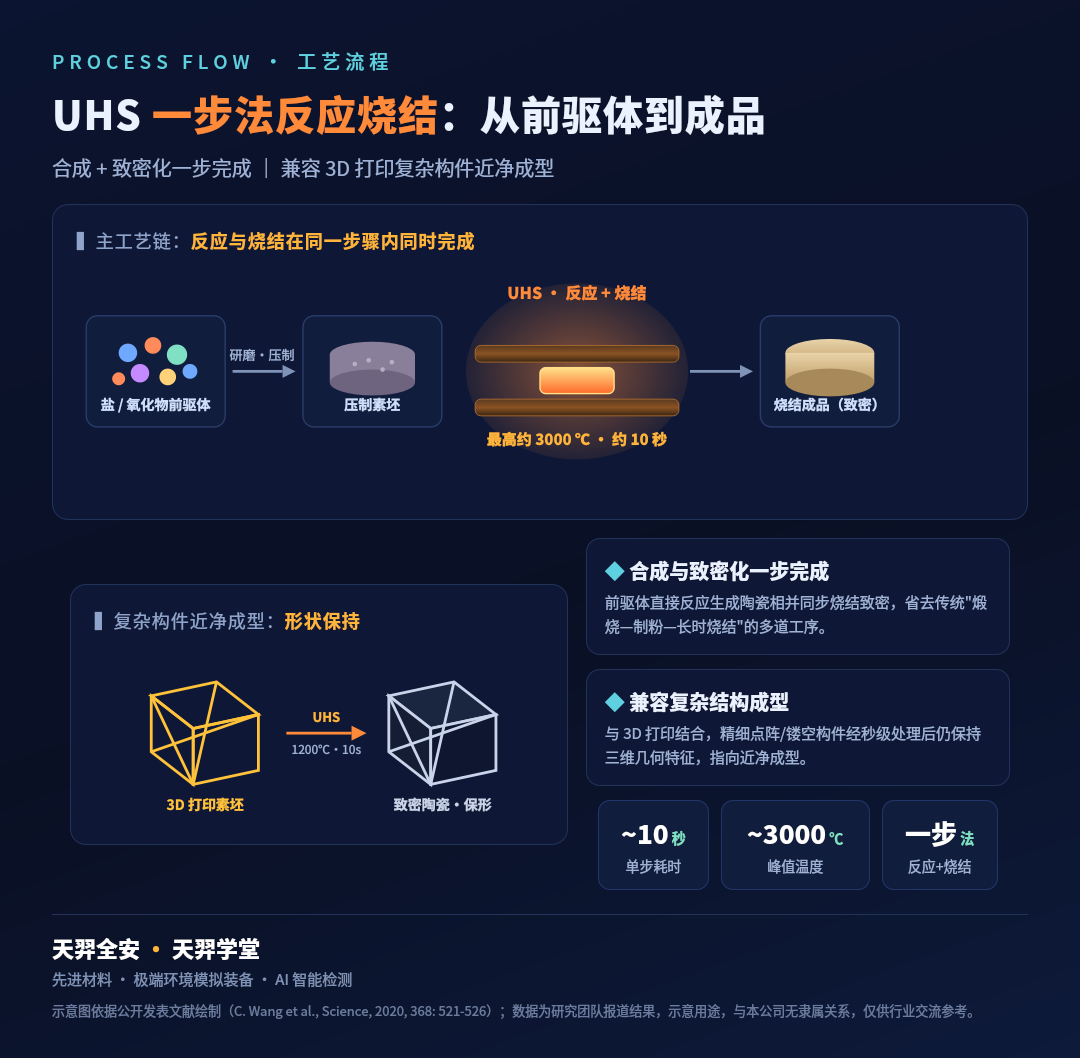
UHS Technology Deep Dive (Part 2): One-step reactive sintering compresses synthesis and densification into a high-temperature window of approximately 10 seconds, while enabling near-net-shape fabrication of complex components via 3D printing. This delivers a synergistic leap in both efficiency and design freedom for thermal protection material manufacturing.
One-step: Grow ceramics directly from precursors
Traditional ceramic fabrication typically involves multiple steps: calcination of precursors to synthesize ceramic phases, powder processing, shaping, and prolonged high-temperature sintering for densification—resulting in a lengthy, multi-stage process. In contrast, the UHS process enables the research team to grind or press salt or oxide precursors into green bodies, then directly feed them into a Joule heating zone formed by carbon paper or graphite strips. Under extreme conditions of up to 3000°C for approximately 10 seconds, ceramic phase synthesis and densification (sintering) occur simultaneously in a single step, yielding finished sintered products immediately.
For R&D of ceramics via the precursor route, this "reaction + sintering integration" concept is highly inspiring. It compresses the traditionally separate synthesis and densification steps into a very short high-temperature window, enabling faster validation of new ceramic compositions.
Maintains Shape: Complex Structures Instantly Sintered
3D printing unlocks design freedom for complex ceramic structures, but a longstanding challenge remains: green bodies often deform, shrink unevenly, or crack during pyrolysis and sintering due to organic binder volatilization and thermal stress release. As a result, intricate fine features are frequently "printable but not sinterable."
In this study's demonstration, 3D-printed complex lattice/porous green bodies were converted into dense ceramics via UHS treatment (approx. 1200°C for approx. 10 s), with their intricate 3D geometries well preserved. The extremely rapid heating and cooling not only shortened processing time but also helped suppress defect formation and propagation—offering a new pathway for "additive manufacturing + rapid densification" near-net-shape fabrication.
Why this is especially critical for thermal protection materials
In aerospace and related fields, requirements for thermal protection components extend beyond "high-temperature resistance" to include complex geometries, lightweight lattice structures, and integrated manufacturing. A technology route capable of rapidly synthesizing ceramics from precursors while accommodating the molding of complex components precisely addresses this intersection:
- Material Level: Provides rapid synthesis and densification tools for hard-to-sinter systems such as high-entropy ceramics and non-oxide ceramics.
- Structural level: Combine with 3D printing to explore near-net-shape manufacturing of complex thermal protection components;
- R&D Paradigm Level: Enables high-throughput screening with second-level experiments, mutually empowering AI-driven materials discovery.
Conclusion
From multi-step, hour-long processes to one-step, second-level成型, UHS demonstrates a synergistic leap in efficiency, composition, and structural freedom for advanced ceramic manufacturing. Tianyi Quan'an focuses on rare-earth high-entropy silane precursor ceramics (PHEC) thermal protection materials, building an ecosystem around "advanced materials · extreme environment simulation equipment · AI-powered inspection." We continuously track the evolution of cutting-edge manufacturing and characterization technologies—because understanding how to build materials faster and better is the foundation of our service for high-end equipment operating in extreme environments.
This article provides industry educational information. All process flows and technical data cited are from publicly published literature (C. Wang et al., "A general method to synthesize and sinter bulk ceramics in seconds", Science, 2020, 368: 521-526) and public reports. The related research was conducted by third-party research institutions and is not affiliated with our company. This content is for industry exchange and reference purposes only.
Technical Cooperation Inquiry
Interested in the content or want to learn more? Contact us.
Get Started