
Reusable Rockets: From "Disposable Heat Shielding" to "Designed for Repair"

In the past, rocket heat shields were single-use, discarded after each flight—just like the rockets themselves. But when rockets are designed for recovery and reuse, the rules change completely: heat shields can no longer be "use-and-throw." They must be inspectable, repairable, and capable of withstanding repeated flights. This marks a paradigm shift in both materials and philosophy.
Introduction: When Rockets Are No Longer Disposable
For decades, the underlying logic of spacecraft thermal protection was simple: a rocket flies once, its heat shield burns once, and the system is discarded after the mission. Materials only needed to survive that single flight; reusability was never a consideration.
But when SpaceX's Falcon 9 successfully recovered its first stage, and Starship began attempting full reusability, the entire design philosophy for thermal protection systems had to be rewritten:The thermal protection system is no longer a consumable; it must be an engineerable system that is maintainable, inspectable, and repairable.
This isn't just a material upgrade—it's a paradigm shift from disposable thinking to reusable thinking.
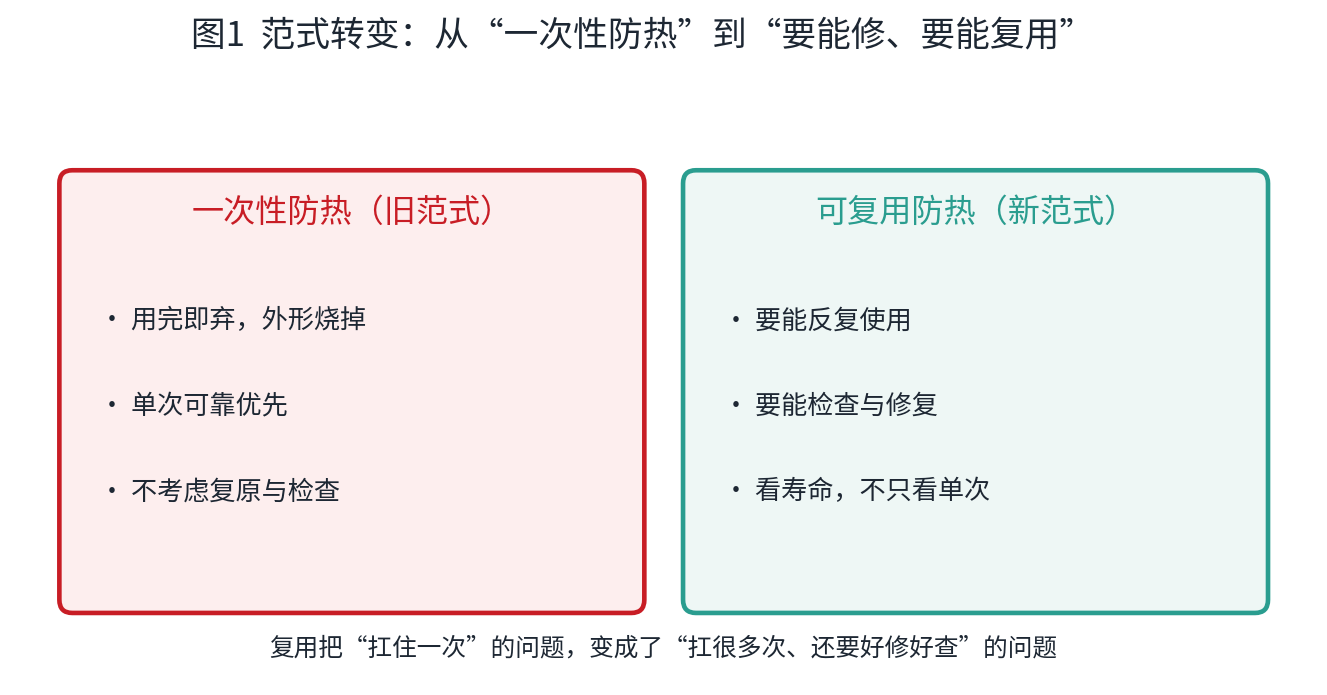
1. Disposable vs. Reusable: The Core Divide in Heat-Resistant Design
The thermal protection design of traditional expendable rockets aims toPeak PerformanceUnder the most severe reentry conditions, materials only need to survive for a few minutes. Ablative thermal protection systems (such as PICA and AVCOAT) are designed for this purpose: they dissipate heat by ablating away, at the cost of significant material consumption after each flight.
Reusable rockets require thermal protection systems with entirely different characteristics:
- Non-ablative or low-ablativeMaterials must not deplete significantly with each flight.
- Structural Integrity MaintainedMaintains mechanical properties after multiple thermal cycles
- Detectability: Enables assessment of internal damage status through non-destructive testing.
- RepairabilityLocalized damage can be restored through on-site repair.
- Rapid turnover: Inspection and repair must be completed within a reasonable timeframe.
This means the design goal for reusable thermal protection systems shifted from "single-use maximum protection" to "multi-mission reliability + maintainability."
II. The real barrier isn't "heat resistance," it's "inspectability and repairability."
Many believe the challenge of reusable heat shields lies in finding more heat-resistant materials. In reality, temperature resistance is just the baseline.The real engineering barrier lies in detection and repair.。
Take the Space Shuttle's thermal tiles as an example: each tile must be individually inspected after every flight. Any cracked or missing tiles need to be replaced. This process is extremely time-consuming and labor-intensive, contributing significantly to the Shuttle's inability to achieve rapid reuse.
Next-generation reusable thermal protection systems must address three core challenges:
- How do I know where the issue is?——Need reliable non-destructive testing (NDT) technology to detect hidden defects like internal micro-cracks, delamination, and oxidation without disassembly.
- Can it be fixed?Develop on-site repair processes instead of sending units back for major overhauls every time.
- Is it safe to use after repair?— Establish performance validation standards and life prediction models for repaired components.
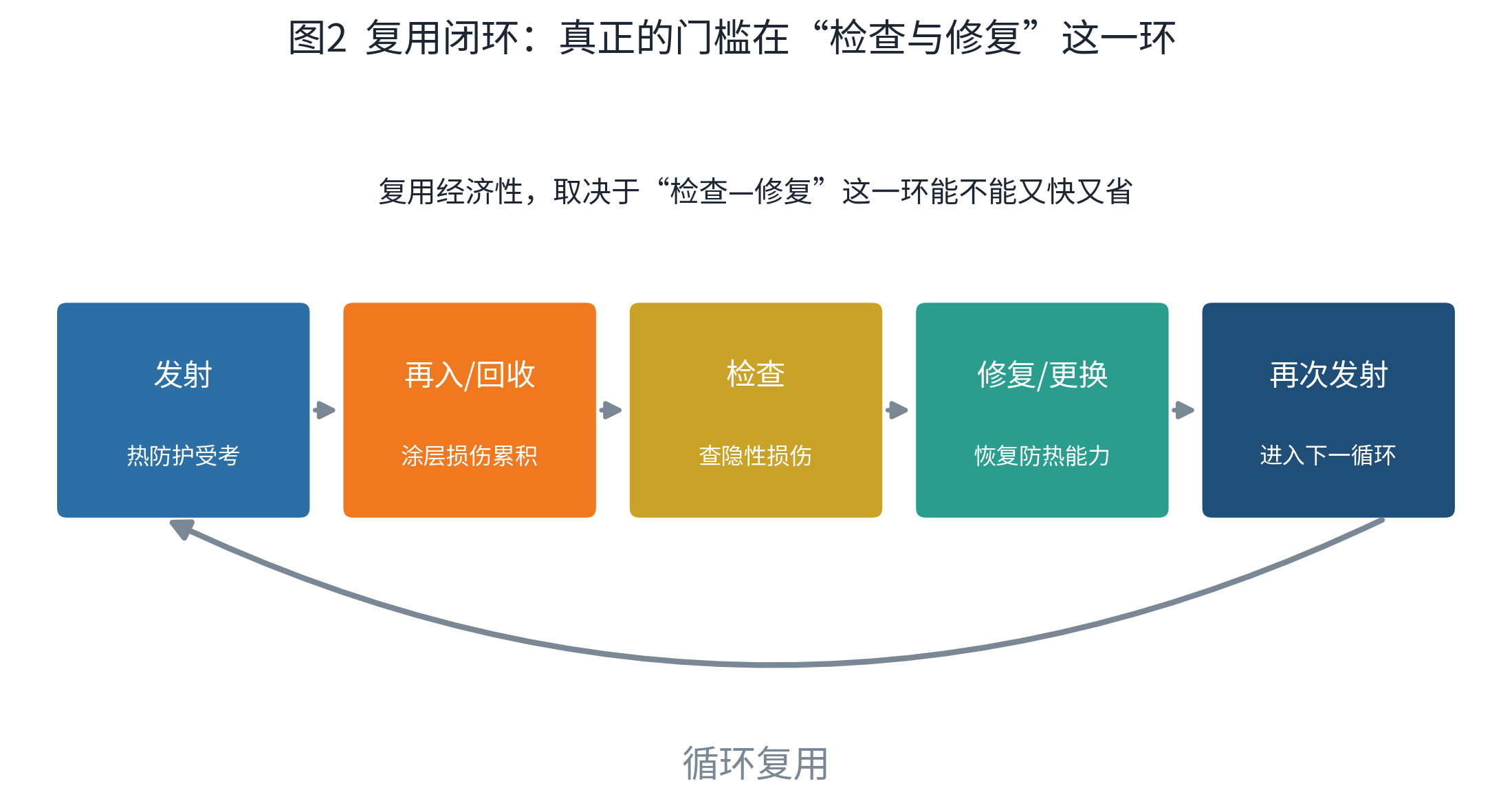
III. Three Key Challenges: Reliability, Repairability, and Turnaround Speed
Challenge 1: Multi-cycle Reliability
Repeated exposure to extreme thermal cycling alters the material's microstructure: grain growth, cumulative phase transformations, and interface degradation. These changes can gradually reduce thermal protection performance. Accurately predicting the remaining service life after N flights is a core challenge in reusable design.
Challenge 2: Field Repairability
Ideally, thermal protection system repairs should be as standardized and modular as replacing car brake pads. In practice, however, the high integration of thermal materials and structures means local repairs can trigger cascading changes. Simplifying the repair process while ensuring quality is key to engineering implementation.
Challenge 3: Rapid Turnaround
The economic value of reusability depends on turnaround speed. If the thermal protection system requires weeks or even months to inspect and repair after each flight, the cost savings from reuse will be offset by extended ground time.The maintenance cycle of the thermal protection system directly determines the upper limit of rocket reusability.
4. Tianyi Perspective: Designed for "Repairability"
At Tianyi Quan'an, we believe reusable thermal protection system design should not be about "patching" traditional solutions, but rather addressing the root cause from the start.MaintainabilityAs a core design constraint.
This means:
- Consider testability and repair compatibility during material selection.
- Design the structure with inspection channels and repair interfaces预留.
- Embed health monitoring sensors during manufacturing.
- Build a complete digital twin model to support condition-based maintenance decisions.
The competition in heat-resistant materials is shifting from "who withstands higher temperatures" to "who is easier to maintain."This is not just a technical issue, but a shift in systems engineering thinking.
Read More
- "Health Check" of Heat-Resistant Materials: An Overview of Non-Destructive Testing Technologies
- From Lab to Launch Site: The Engineering Journey of Thermal Protection Materials